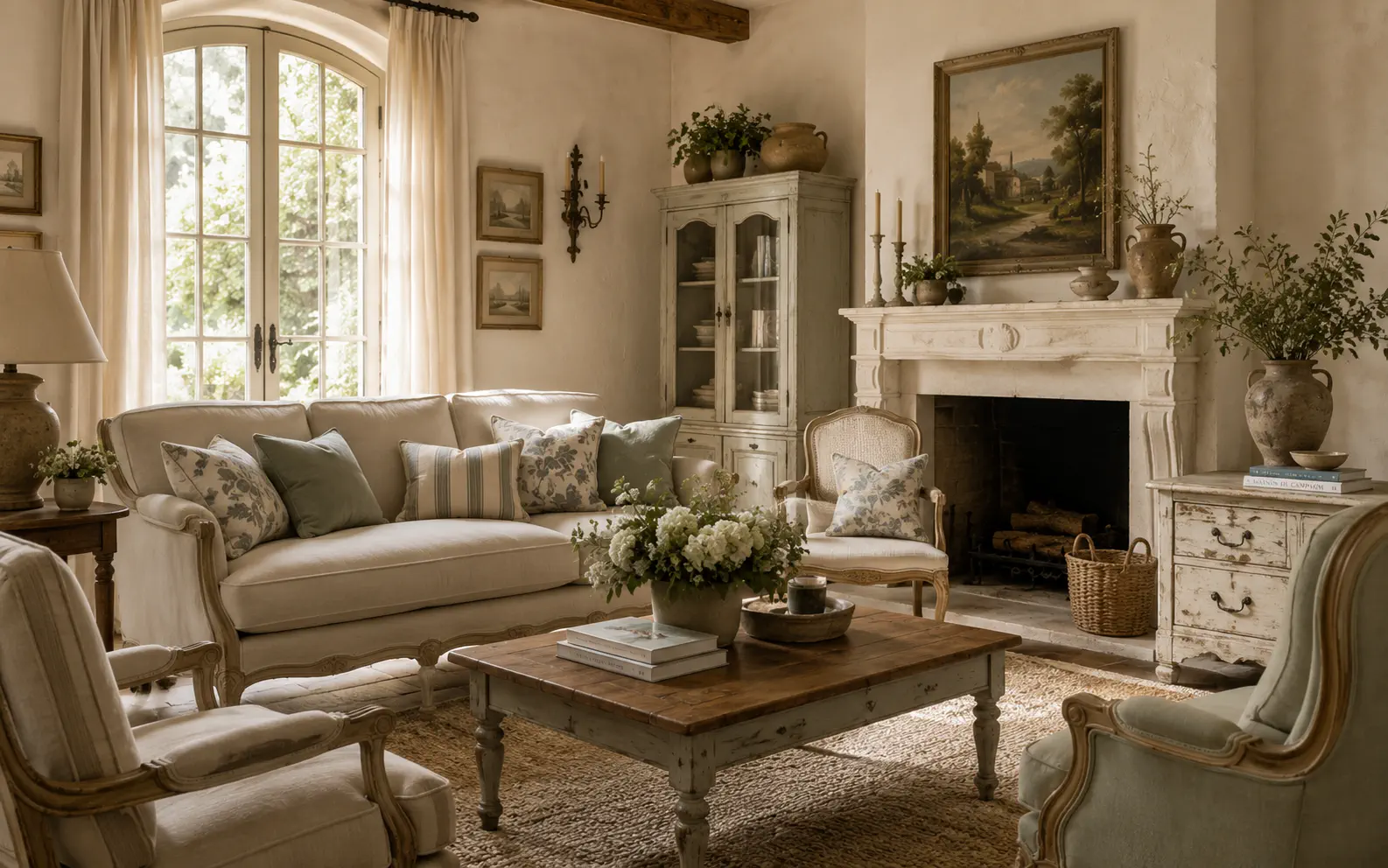
French country interior design is what happens when rustic and refined stop competing. Born in the farmhouses and manors of Provence and the wider French countryside, it pairs honest rural materials — stone floors, timber beams, linen — with a genuine elegance of shape and proportion. The result is a look that feels sun-faded, gracious and lived-in all at once: comfortable enough for a family kitchen, but with curves and craftsmanship that lift it well above plain rustic. This guide covers what defines the style, its palette and materials, the furniture that carries it, and how to achieve it without tipping into costume.
French country sits in the same family as farmhouse and rustic design but reads noticeably more refined. If you are comparing rural looks before choosing, the guide to interior design styles puts them side by side, and the free interior design styles guide gives you a printable comparison.
What is French country interior design?
French country — sometimes called French provincial or, in its sunnier southern form, Provençal — takes the practical materials of rural French homes and combines them with the shapes and details of French decorative tradition. Stone and plaster walls, exposed beams and terracotta floors provide the rustic backbone; carved and curved furniture, gently faded colour and delicate textiles supply the elegance.
The defining quality is softness. Colours look sun-bleached rather than fresh from the tin. Timber is often painted and lightly worn back rather than left raw. Metalwork is aged wrought iron or dulled brass. Nothing gleams. That gentle, weathered quality is exactly why the style feels welcoming instead of grand, even when the individual pieces are genuinely fine.
It is also unmistakably domestic. French country was never a decorating scheme; it is what comfortable rural houses looked like when good furniture was handed down and kitchens were the centre of life. Keeping that spirit — usable, generous, slightly imperfect — is what separates a convincing French country room from a themed one.
The defining features of French country style
A few signatures identify the style immediately:
- Soft, faded colour — creams, warm whites, dove greys, lavender, sage and pale blues.
- Natural, textured surfaces — stone or terracotta floors, plaster walls, exposed timber beams.
- Curved, carved furniture — cabriole legs, scalloped edges, gently shaped chair backs.
- Painted and distressed timber — armoires, dressers and chairs in worn-back chalky paint.
- Toile, gingham and linen — classic French textiles used with restraint.
- Aged wrought iron and brass — light fittings, curtain poles, chandeliers, hardware.
- Rustic-elegant contrast — a rough farmhouse table beneath a delicate chandelier.
That final contrast is the heart of the look: the style works precisely because rough and refined sit in the same room.
Palette, materials and textures
The French country palette is drawn from the landscape and softened by sunlight. Build on a base of warm white, cream or pale stone, then layer in the muted tones of Provence: lavender and soft violet, sage and olive green, faded blues from pottery and shutters, and the warm ochres and terracottas of southern earth. Everything should look slightly aged — think of a colour that has spent twenty summers in the sun.
Materials do the heavy lifting. Floors in stone, terracotta tile or wide worn timber; walls in lime plaster or simple paint; ceilings with exposed beams where the architecture allows. Add natural stone or timber worktops, ceramic and enamel in the kitchen, woven rush and cane seating, and generous quantities of linen in curtains, slipcovers and bedding. Textiles are where pattern enters: toile de Jouy scenes, small checks and gingham, ticking stripes and simple floral prints, used on one or two elements rather than everywhere at once.
Furniture and decorative details
French country furniture is defined by shape. The signature pieces are the armoire (a tall carved wardrobe or cupboard), a long farmhouse dining table, curved-back or rush-seated chairs, a painted dresser or buffet displaying crockery, and comfortable upholstered seating in linen or cotton slipcovers. Legs curve, edges are shaped, and carving is present but never heavy — this is elegance at domestic scale, not palace furniture.
Details finish the look: a wrought-iron or crystal chandelier over a plain table, gilt-framed mirrors, ceramic pitchers and bowls, dried lavender or garden flowers in simple jugs, copper pans on display, woven baskets, and open shelving with everyday china. Because the palette is so restrained, these accents read as warmth rather than clutter. Aim for pieces that look collected over years, which is also why genuine antique or second-hand finds work far better here than a matching set bought at once.
Modern French country
Most people today want the feeling of French country without the full weight of pattern and ornament, and the modern interpretation delivers exactly that. It keeps the faded palette, natural materials, curved furniture and linen, but strips back the busyness: fewer florals, less toile, cleaner walls, simpler window treatments and more negative space. Black or dark metal accents often replace some of the gilt, and one or two contemporary pieces are allowed in.
Think of modern French country as the style edited down to its best instincts — the shapes, the softness and the materials, with the fussiness removed. It sits comfortably alongside contemporary interior design and modern farmhouse, which is why it suits current homes so well.
Getting the look room by room
Kitchen. The natural home of the style: a large timber or stone-topped table, painted cabinetry in a soft chalky tone, open shelves with everyday china, copper and ceramic on display, and a simple pendant or small chandelier overhead.
Living room. Linen slipcovered seating, a painted or timber coffee table, a gilt mirror, one patterned textile (a toile cushion, a striped throw) and plenty of warm neutrals.
Bedroom. Layered white and cream linens, a curved or iron bedframe, a painted bedside table, and lavender or garden flowers. Restrained pattern keeps it restful.
Bathroom and entry. Stone or terracotta underfoot, aged brass fittings, a simple wooden bench or console, hooks and baskets. Utility handled with grace is very much the point.
Common French country mistakes
The biggest risk is over-decorating into pastiche: too many roosters, too much toile, florals on every surface, and everything artificially distressed. French country should look like a home that grew over time, not a themed room. Choose one or two patterns, let large surfaces stay quiet, and mix genuinely old pieces with plain new ones.
The second mistake is colour that is too bright or too clean. Fresh saturated lavender or crisp primary blue instantly breaks the illusion; the palette must read sun-faded and slightly dusty. Get the softness of the colour and the honesty of the materials right, and the style largely assembles itself. The underlying fundamentals — balance, texture, light and proportion — are covered in the guide to the elements of interior design. Designers documenting this kind of work can build a designer website and get started free to present it properly.
Frequently asked questions
What is French country interior design?
French country interior design combines the practical materials of rural French homes — stone or terracotta floors, plaster walls, exposed beams, linen — with the elegance of French decorative tradition: curved carved furniture, painted and gently distressed timber, and a soft sun-faded palette. The result is rustic and refined at once, welcoming rather than grand.
What colours are used in French country design?
Start with warm white, cream or pale stone, then layer muted tones drawn from the French landscape: lavender and soft violet, sage and olive green, faded pottery blues, and warm ochre or terracotta. Every colour should look slightly sun-bleached and dusty rather than fresh and saturated — bright, clean colour instantly breaks the effect.
What is the difference between French country and farmhouse style?
They share rural roots and natural materials, but French country is noticeably more refined. Farmhouse leans on simple practical timber, shiplap and warm neutrals, while French country adds curved carved furniture, painted and distressed finishes, toile and gingham textiles, aged wrought iron or gilt, and a softer faded palette. The rough-meets-elegant contrast is what defines French country.
What is modern French country style?
Modern French country keeps the faded palette, natural materials, curved furniture and linen, but strips back the busyness: fewer florals and less toile, cleaner walls, simpler window treatments, more negative space, and often dark metal accents in place of some gilt. It is the style edited to its best instincts, which suits current homes well.