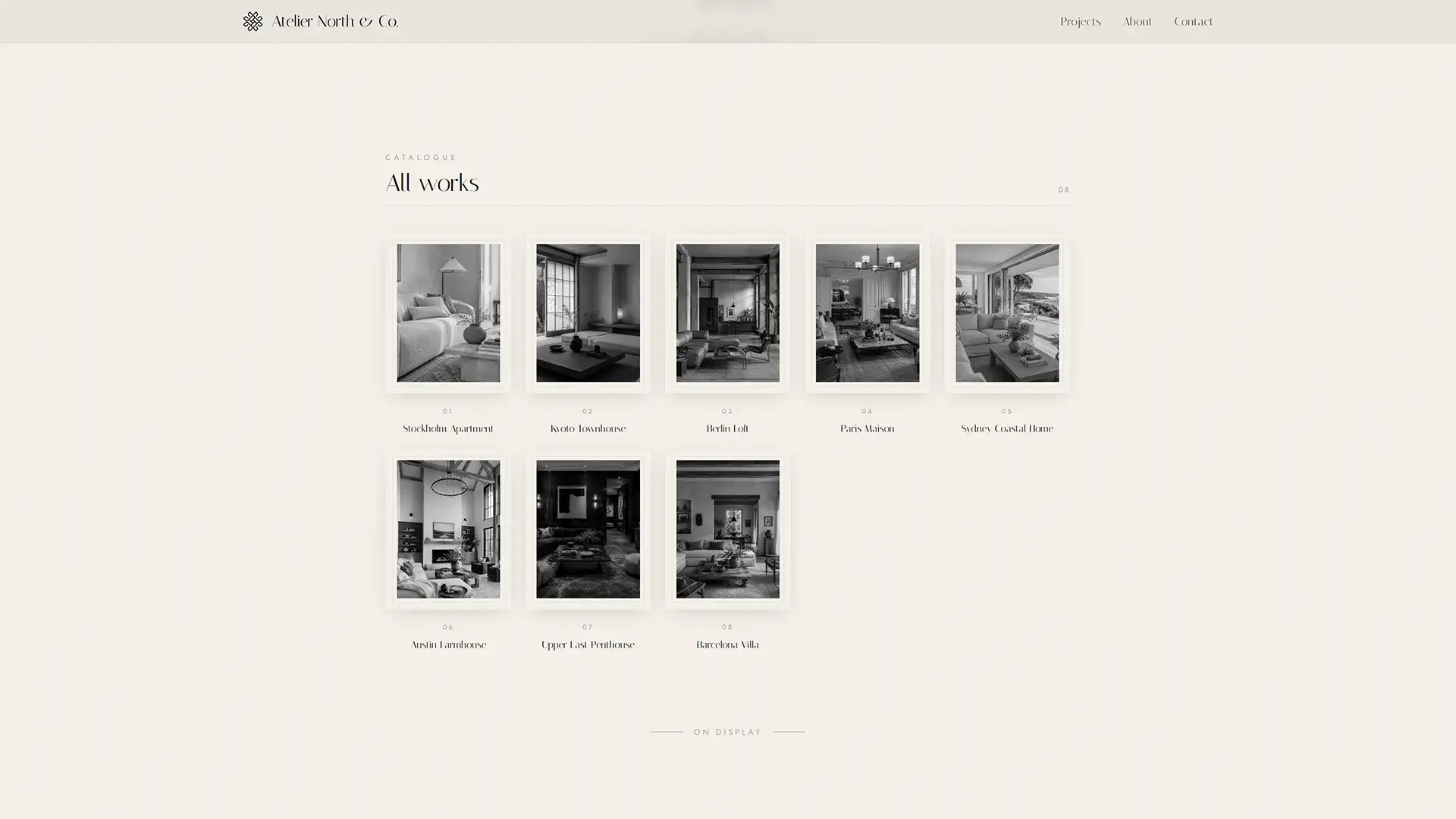
Your interior design portfolio is the single most important sales tool you own. Long before a
prospect ever calls you, they decide whether you are the right designer for their home or commercial
space by looking at your work. A portfolio shows how you think, the spaces you create, the level of
finish you deliver, and — crucially — whether your aesthetic matches theirs. Get it right and the
first conversation is already half-won. Get it wrong and even brilliant work never gets the enquiry.
This guide is the complete reference for building an interior design portfolio that actually wins
clients: what to include, how to structure it, which format to choose, how many projects to show, and
how to publish a professional version quickly. If you would rather follow a build process step by
step, jump to our companion guide on how to make an interior design portfolio.
What is an interior design portfolio?
An interior design portfolio — also called an interior designer portfolio — is a curated collection of
your completed (or concept) projects, presented to demonstrate your style, range and professionalism to
potential clients, employers or collaborators. It is part highlight reel, part case-study library, and part sales page. A good
portfolio does three jobs at once: it proves competence (you can deliver finished, beautiful
spaces), it communicates taste (this is the kind of work I do), and it builds trust (here is
my process, my credentials and how to reach me).
There are two broad audiences, and the best portfolios serve both. Prospective clients want to
imagine their own project in your hands — they scan for rooms like theirs, a style they love, and
evidence you can be trusted with their budget. Hiring studios and recruiters look for range,
technical skill, and how clearly you can articulate a design decision. Whichever you are targeting,
the underlying principle is identical: show your strongest work, tell the story behind it, and make it
effortless to get in touch.
What to include in an interior design portfolio
The contents matter more than the container. A stunning template filled with weak projects still
fails; a simple layout filled with strong, well-told projects wins. Here is what every interior
design portfolio should contain.
Projects (the core)
Projects are the heart of your portfolio. For each one, include:
- High-resolution photography from multiple angles — wide establishing shots that show the whole
space, plus detail shots of materials, joinery, styling and lighting.
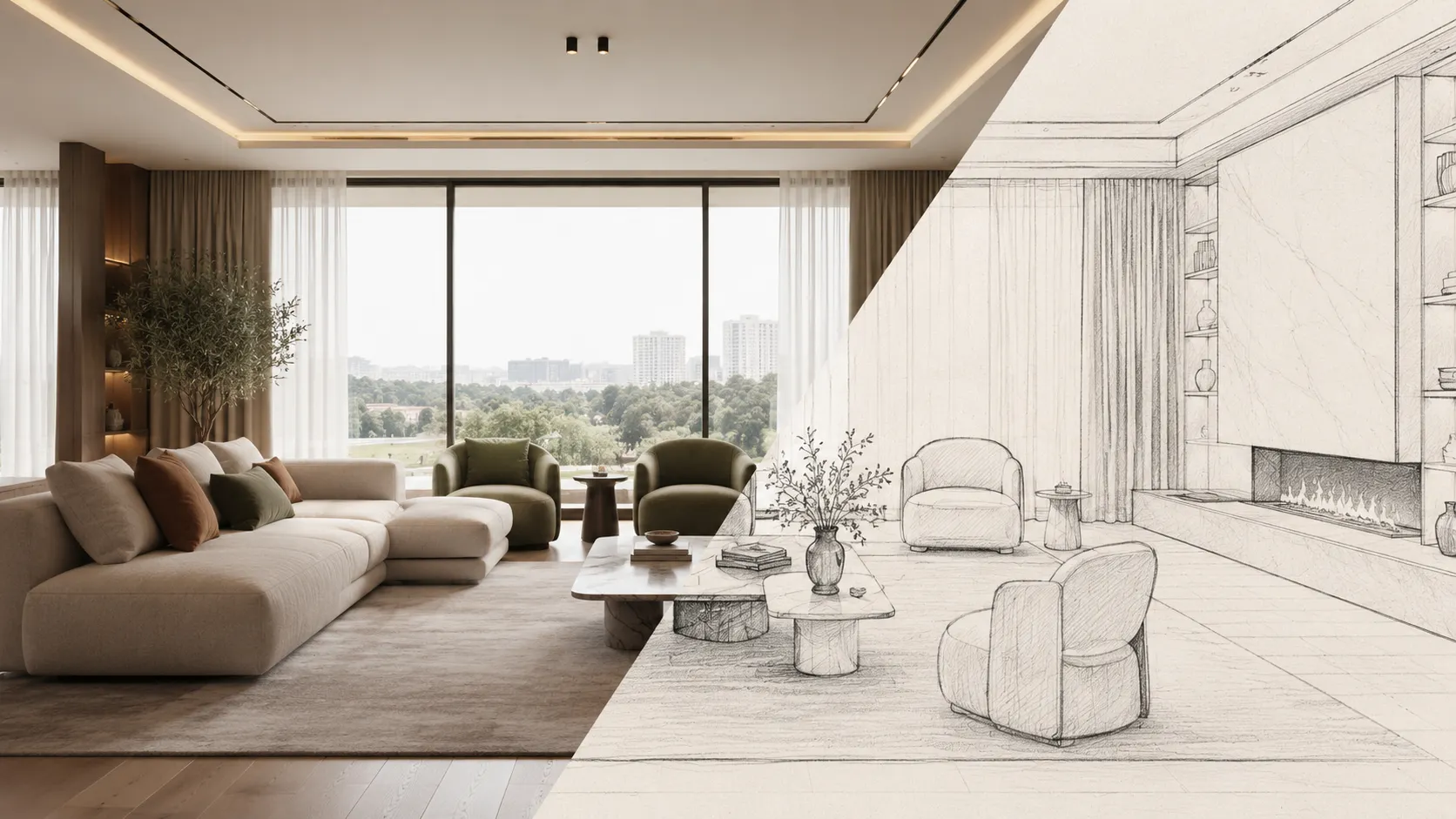
- Before-and-after images wherever you have them. Renovation transformations are some of the most
persuasive content you can show; they prove you solve problems, not just decorate.
- A short project narrative: the client brief, the challenge, your design approach, and the
result. Three or four tight sentences beats three paragraphs.
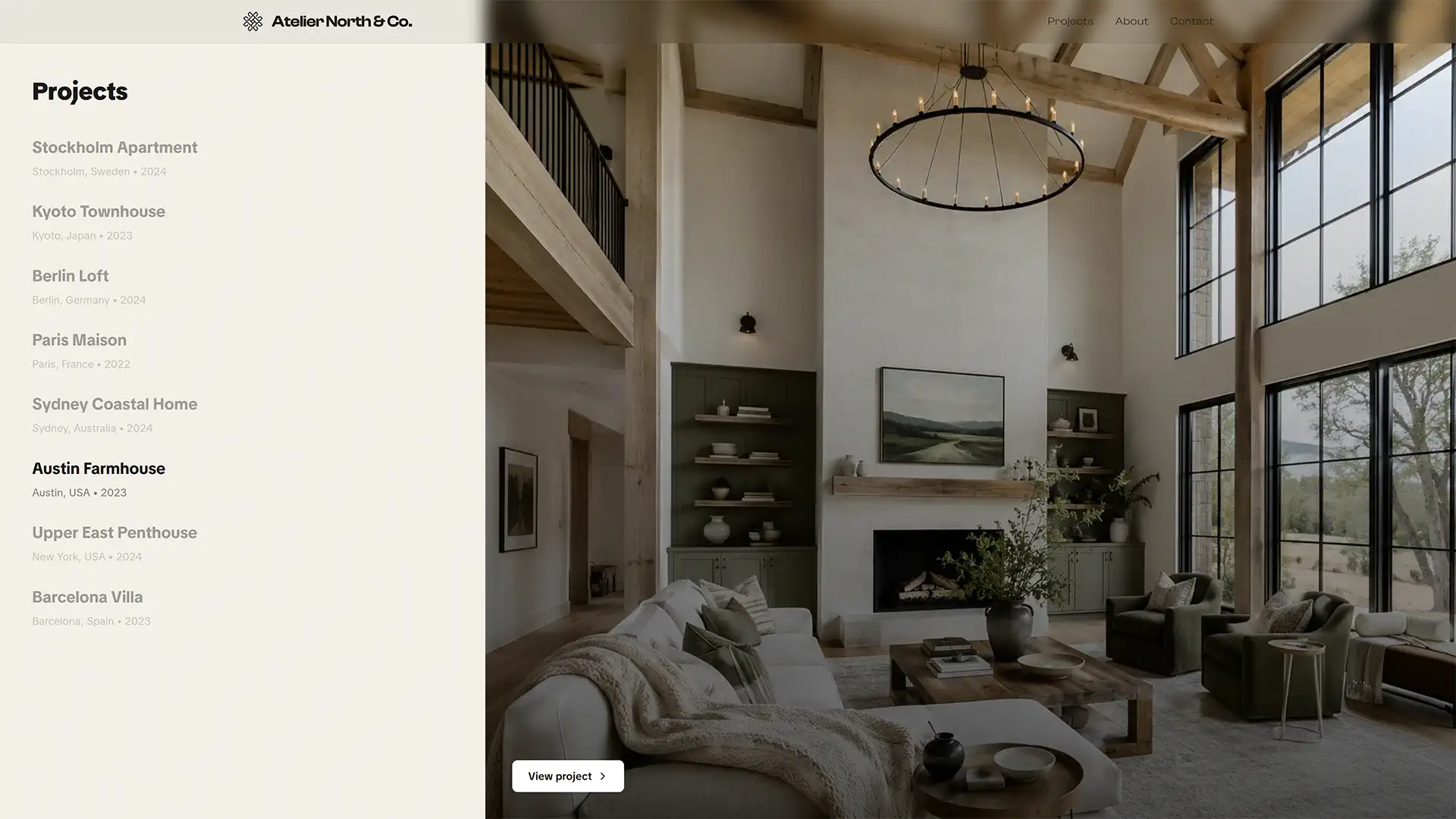
- Scope and context: location, year, approximate square footage, room types, and the services you
provided (full design, styling, FF&E, project management, etc.).
Process
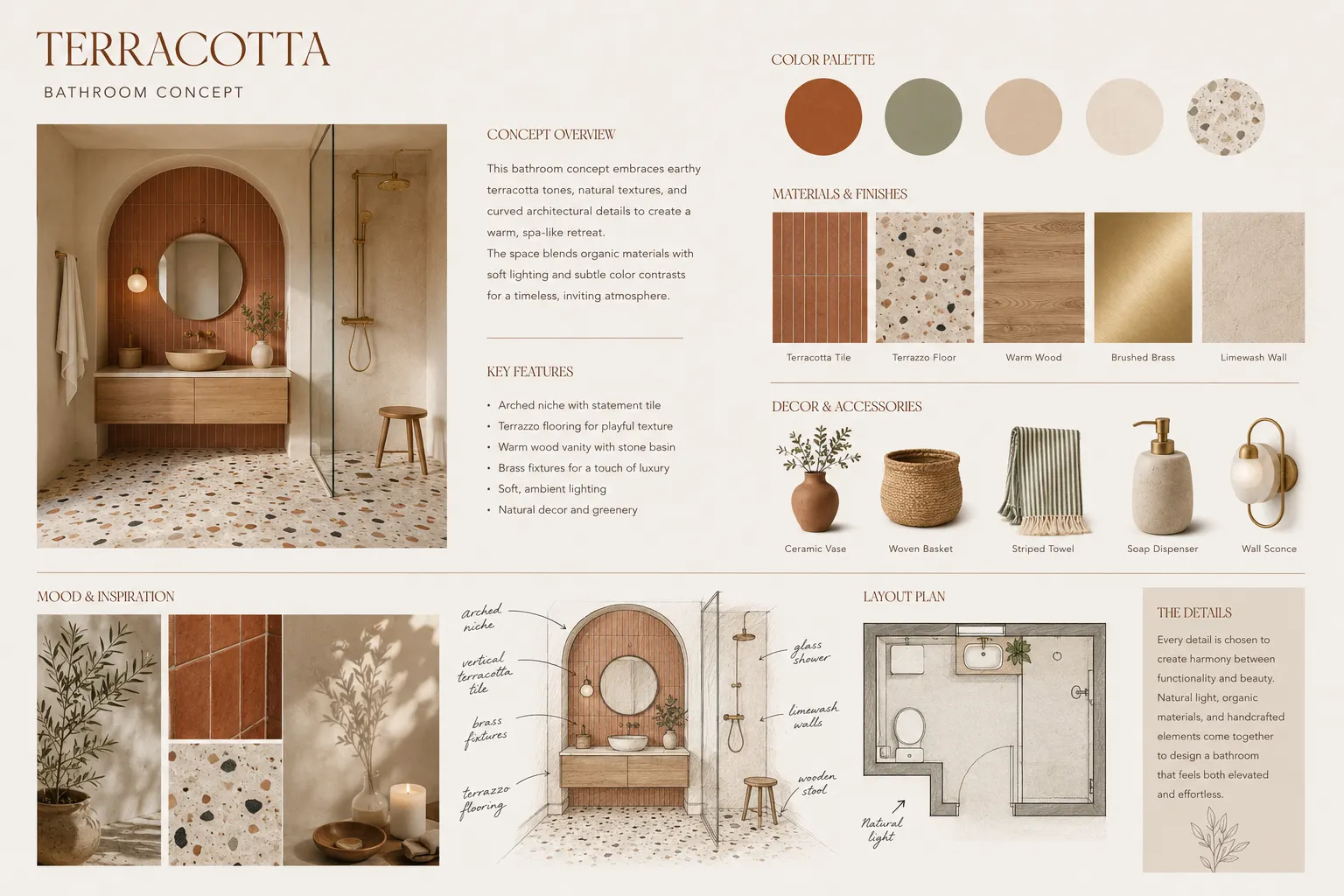
Clients hire designers as much for how they work as for the final look. A glimpse of your process —
mood boards, material palettes, sketches, 3D renders, or a simple "concept to completion" sequence —
reassures clients that there is rigour behind the beauty. It also differentiates you from competitors
who only show glossy end results.
About / bio
A concise About section humanises your portfolio. Cover who you are, your design philosophy in a
sentence or two, your training or credentials, and the type of client or project you love most.
Include a professional photo. People hire people.
Contact and call-to-action
This is the step most portfolios fumble. Every page should make the next move obvious: a contact
form, an email, a "book a consultation" button. If a client has to hunt for how to reach you, you
have lost the enquiry. Treat your contact path as part of the design, not an afterthought.
Testimonials and social proof
A single sentence from a happy client does more persuasive work than another paragraph of
self-description. Sprinkle short client quotes through your project pages — ideally next to the work
they refer to — and, if you have them, add logos of publications, awards or notable clients. Social
proof lowers the perceived risk of hiring you, which is exactly the hesitation standing between a
visitor and an enquiry. If you are early-career and short on testimonials, a line from a tutor, a
mentor, or a satisfied first client is still worth including.
Credentials and recognition
Qualifications, professional memberships (for example a national interior design association),
features in magazines and design awards all belong somewhere visible — usually the About page or a
slim "as featured in" strip. They are not the main event; your work is. But they quietly reassure
clients who are weighing several designers that you are established and accountable.
Digital vs PDF vs print: choosing a format
Designers often agonise over format. Here is the honest comparison.
- Online portfolio (website). The strongest default for almost everyone. It is always up to date,
shareable with a single link, discoverable in Google, mobile-friendly, and effortless to update as
new projects complete. It builds long-term SEO equity under your name.
- PDF portfolio. Indispensable for targeted pitches — sending a tailored selection of relevant
projects to a specific client or for a job application. A PDF is polished and controllable, but it
is static, easily out of date, and invisible to search engines. Best used alongside a website, not
instead of one. (Tip: a good builder lets you export any project to a clean PDF in one click, so you
get both from a single source.)
- Print portfolio. Still valuable for in-person presentations, especially in high-end residential
and hospitality work, where a beautifully produced book signals craft. But it is expensive to
produce and update, so reserve it for premium pitches.
For the overwhelming majority of designers the answer is: build a website first, then export PDFs
from it for specific pitches. You get reach and polish without maintaining two separate portfolios.
Online portfolio vs a portfolio website — what's the difference?
These terms get used interchangeably, but there is a useful distinction. An online portfolio can
live anywhere — a Behance profile, an Instagram grid, a PDF on a cloud drive. A portfolio website
is your own dedicated site, on your own URL, that you control completely. The difference matters for
three reasons:
- Credibility. Your own domain (or a clean subdomain) reads as far more professional than a link
to a social profile shared with millions of other accounts.
- Control. No algorithm decides who sees your work, and no platform places its branding above
yours.
- Discoverability. A real website can rank in Google for your name and your niche, so clients
find you through search — not only through referrals.
Social platforms are excellent distribution channels — post there, but send people back to a website
you own. That site is the asset that compounds over time.
How many projects should an interior design portfolio have?
Quality beats quantity, every time. The sweet spot for most designers is 8–12 strong projects.
Fewer than six can feel thin unless each project is exceptional; more than fifteen and visitors stop
paying attention before they reach your best work. Curate ruthlessly: every project should earn its
place, and a single mediocre inclusion drags down the perceived quality of everything around it.
If you are early in your career and short on completed client work, you have good options — student
projects, personal spaces, styling work, concept boards, and speculative redesigns all count when
presented professionally. The goal is to demonstrate skill and taste, not to prove a long client
list. Lead with your single strongest project; first impressions set the bar for everything that
follows.
Tailor your portfolio to the clients you want
A portfolio is not neutral — it actively attracts some clients and repels others. That is a feature,
not a bug. The work you lead with, the language you use and the projects you include should be
weighted toward the work you want more of, not simply the work you have done most of. If your goal
is high-end residential, open with your most refined residential project and describe it in the
language those clients use. If you want commercial or hospitality contracts, make sure that work is
prominent and that you speak to budgets, timelines and brand fit rather than only aesthetics.
This matters because clients self-select. A homeowner planning a calm, minimal renovation will keep
scrolling if your opening projects are bold and maximalist — even if you could execute their brief
beautifully. By curating toward a clear positioning, you pre-qualify your enquiries: the people who
reach out already like your direction, which makes every subsequent conversation easier and your
close rate higher. It is far better to be the obvious choice for a specific kind of client than a
vague option for everyone.
How to write a project case study that sells
The narrative is where most portfolios are won or lost, so it is worth seeing what "good" looks
like. Compare these two descriptions of the same project:
Weak: "A modern living room renovation with a neutral palette and custom joinery."
Strong: "The owners of a 1930s terraced house had a dark, compartmentalised ground floor that
never felt like home. We removed a structural wall to create a single light-filled living space,
introduced a warm neutral palette to bounce daylight deeper into the room, and designed bespoke
joinery to hide everyday clutter. The result is a calm, sociable space the family now describes as
the heart of the house."
The second version is barely longer, but it does three things the first does not: it establishes the
problem, shows your decisions and reasoning, and ends on an emotional result. That is the
formula — brief, challenge, approach, result — and it works for every project type. You do not need
flowery prose; you need specifics. Square footage, the structural constraint you solved, the exact
material you chose and why: concrete details signal competence in a way adjectives never can.
Interior design portfolio examples
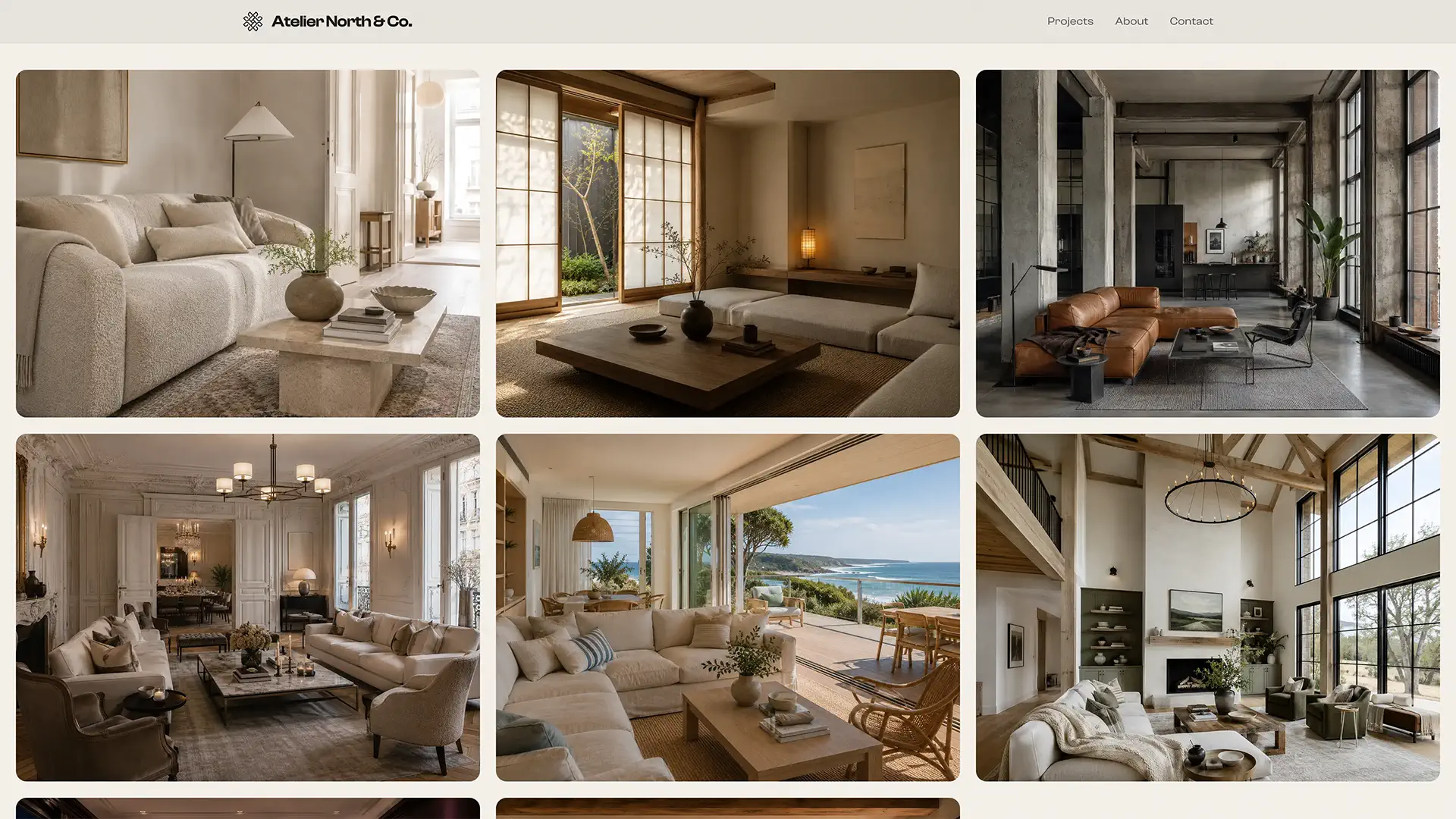
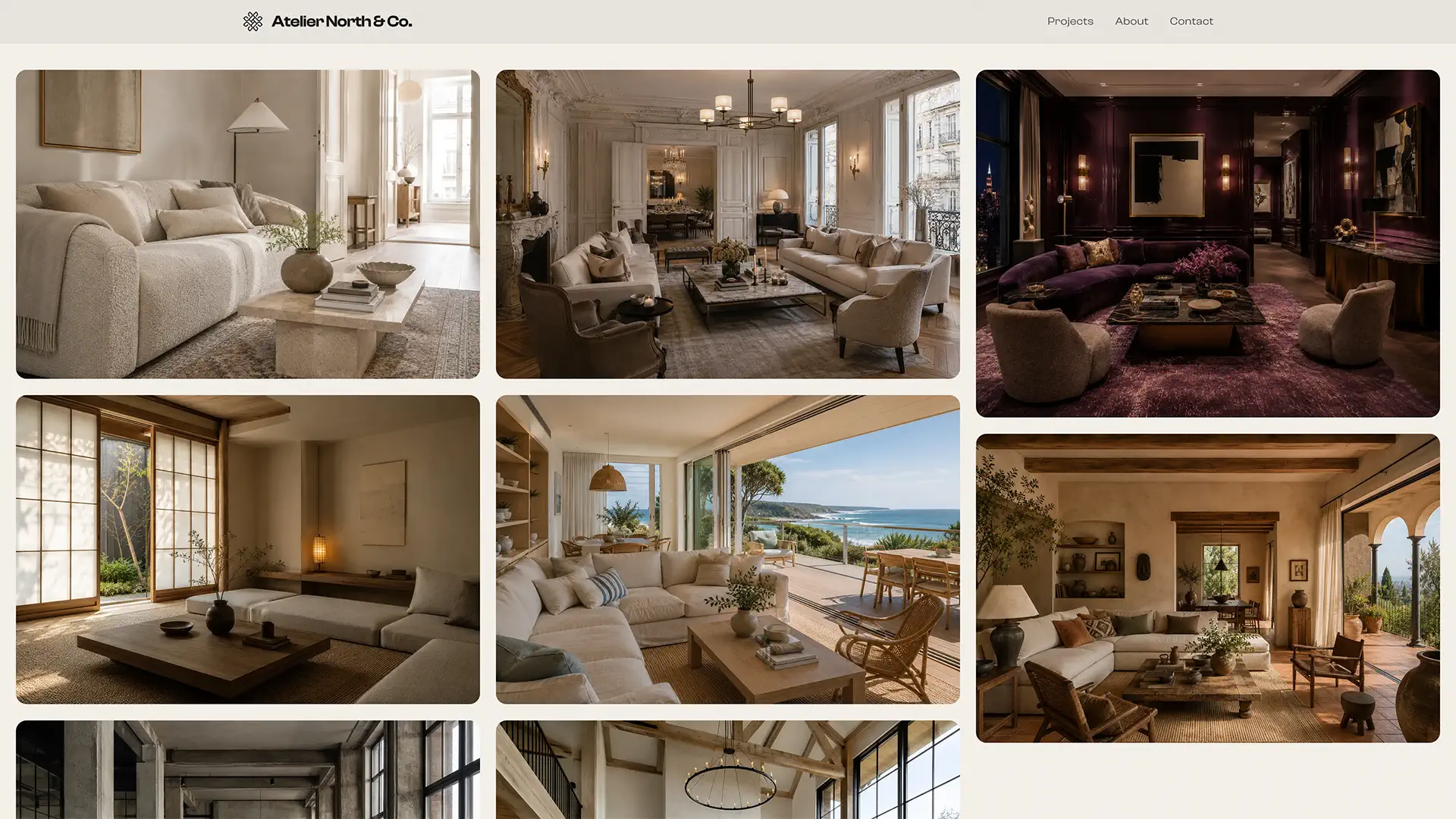
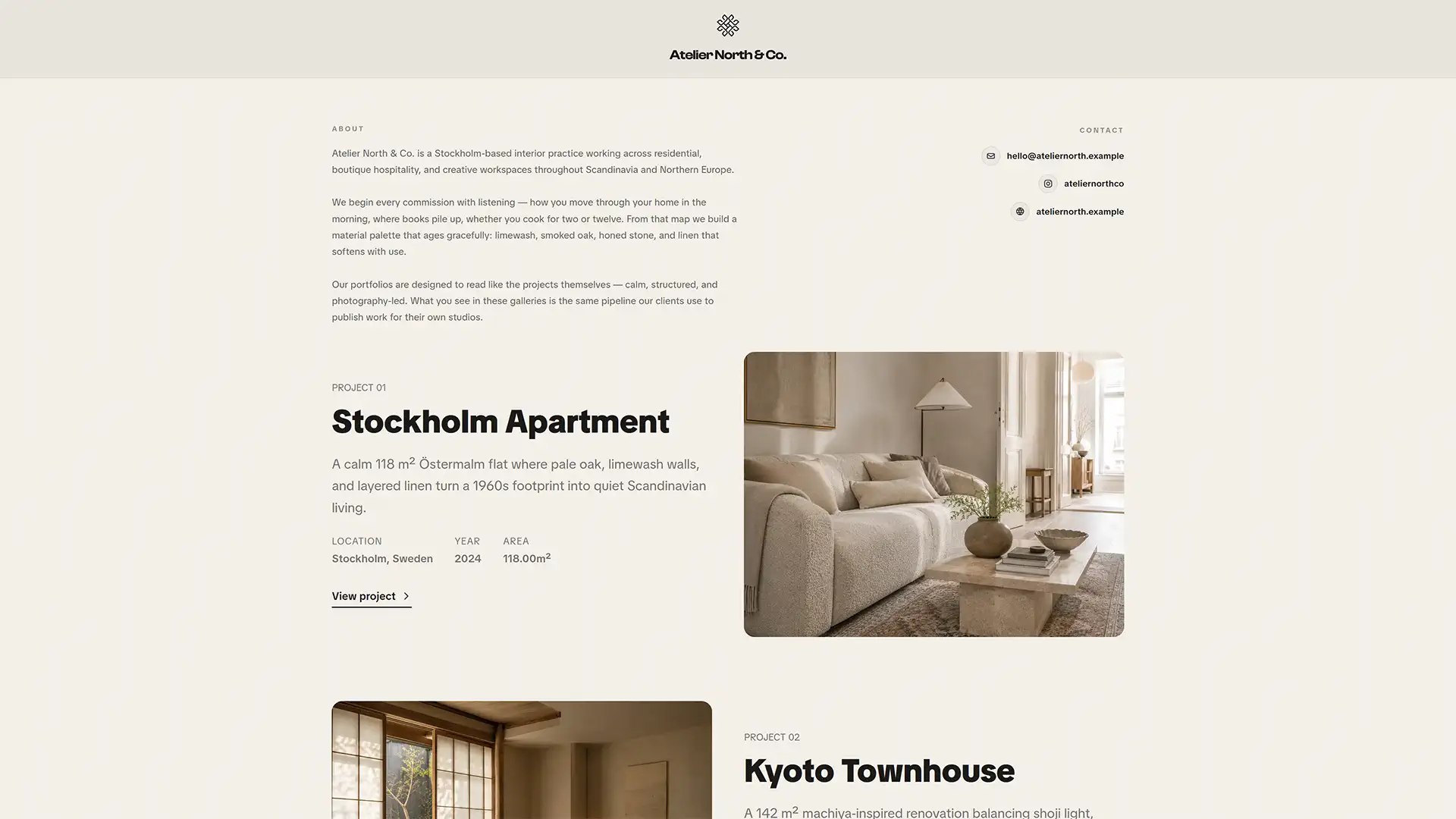
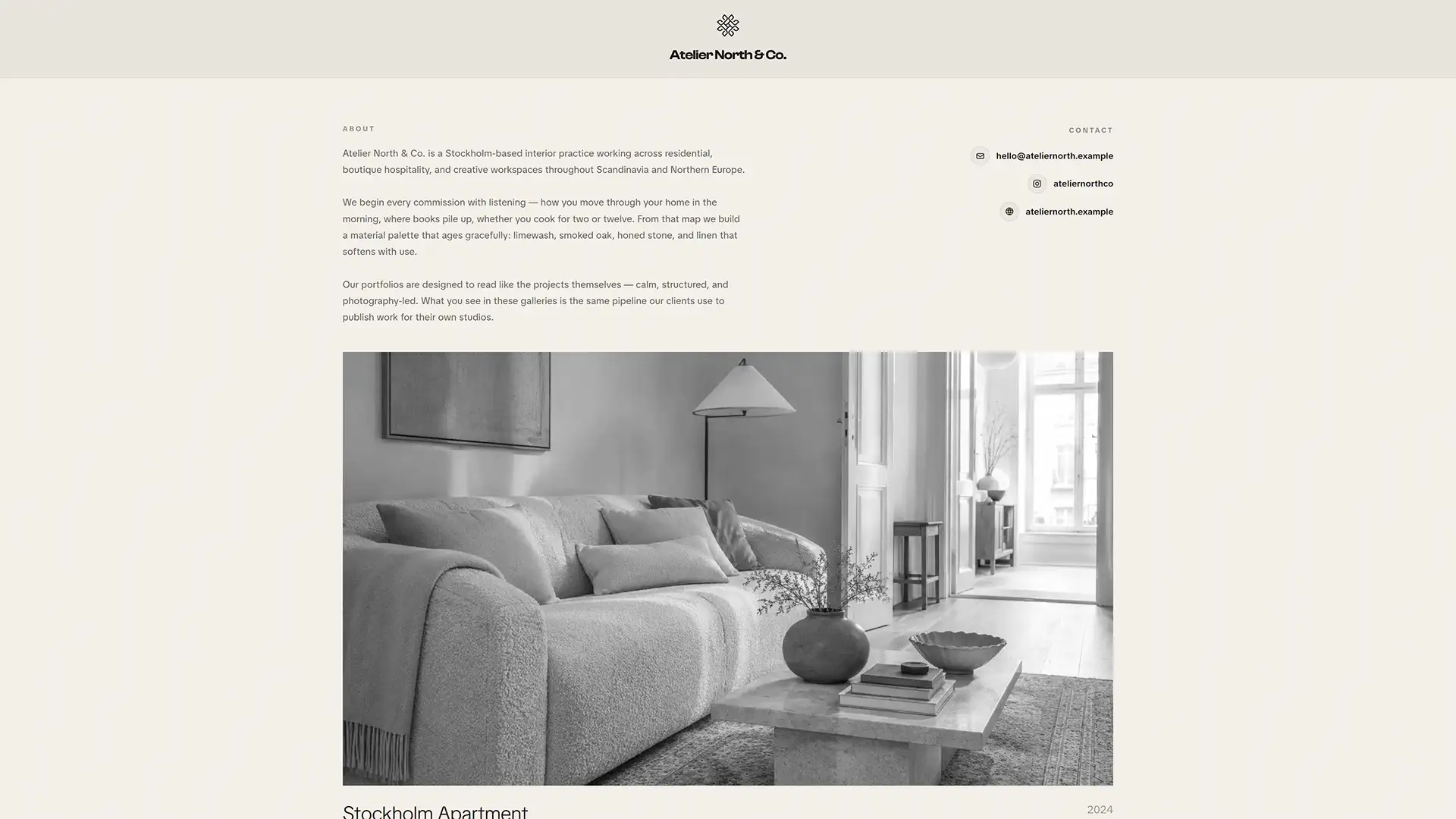
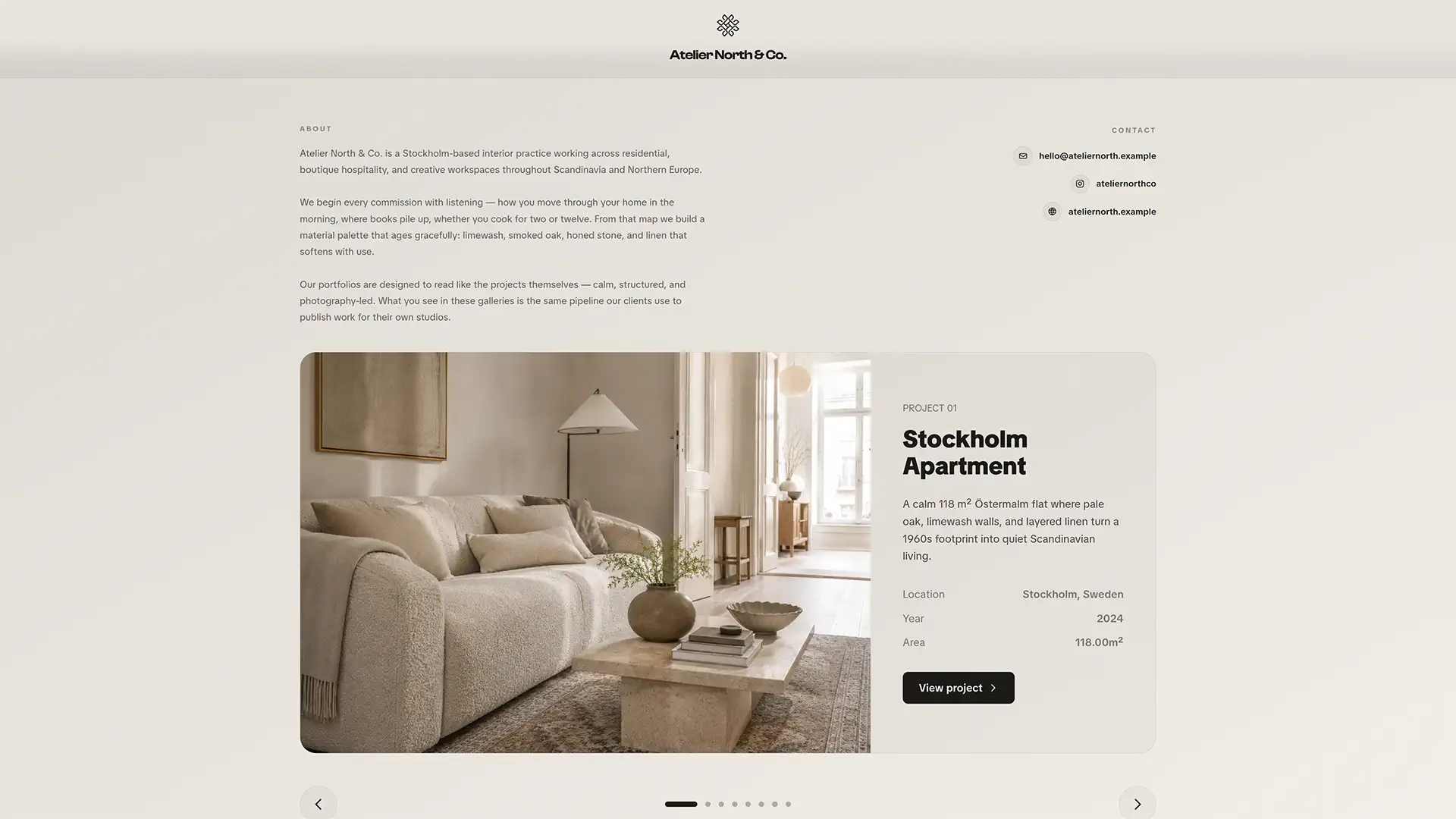
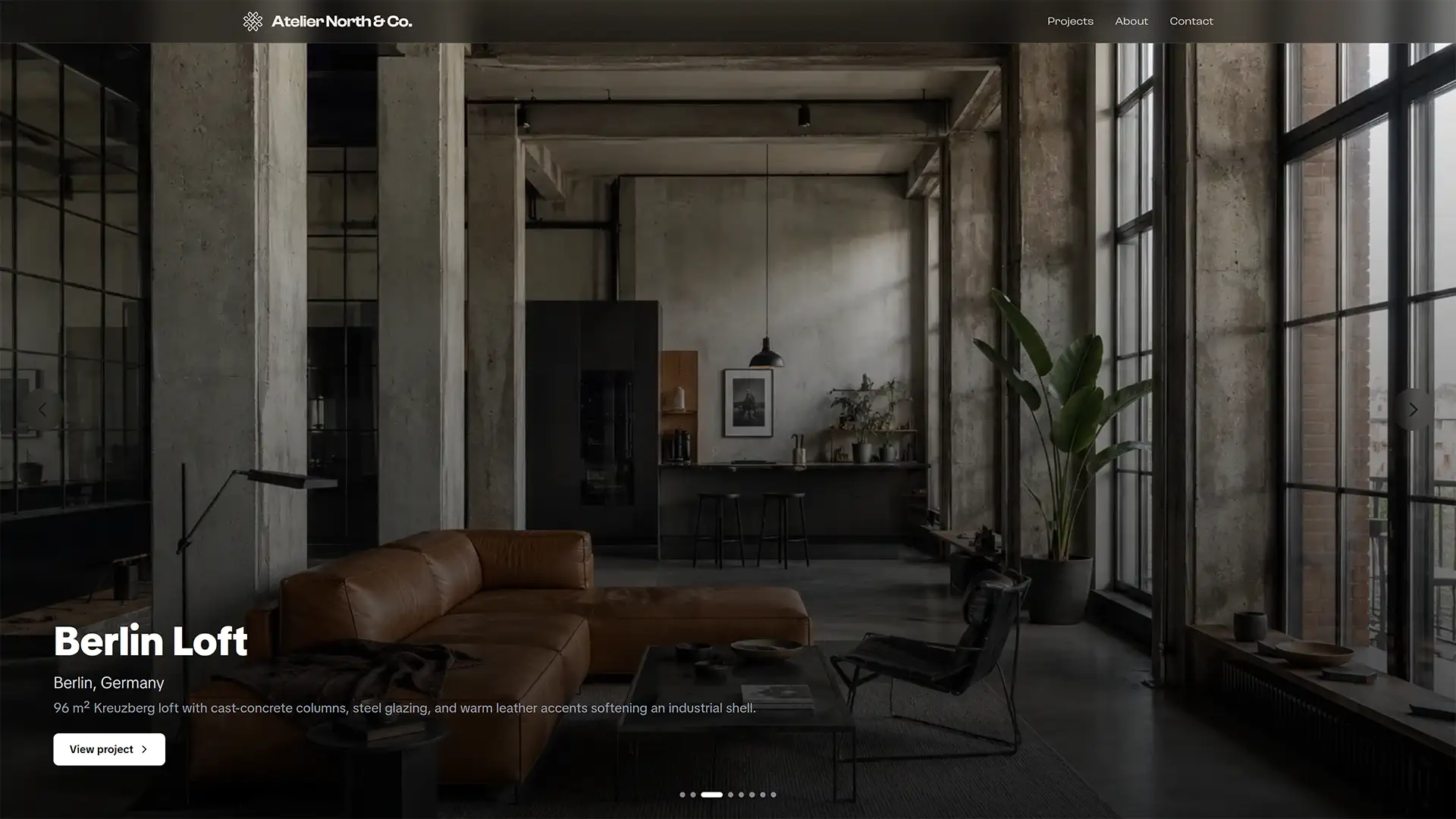
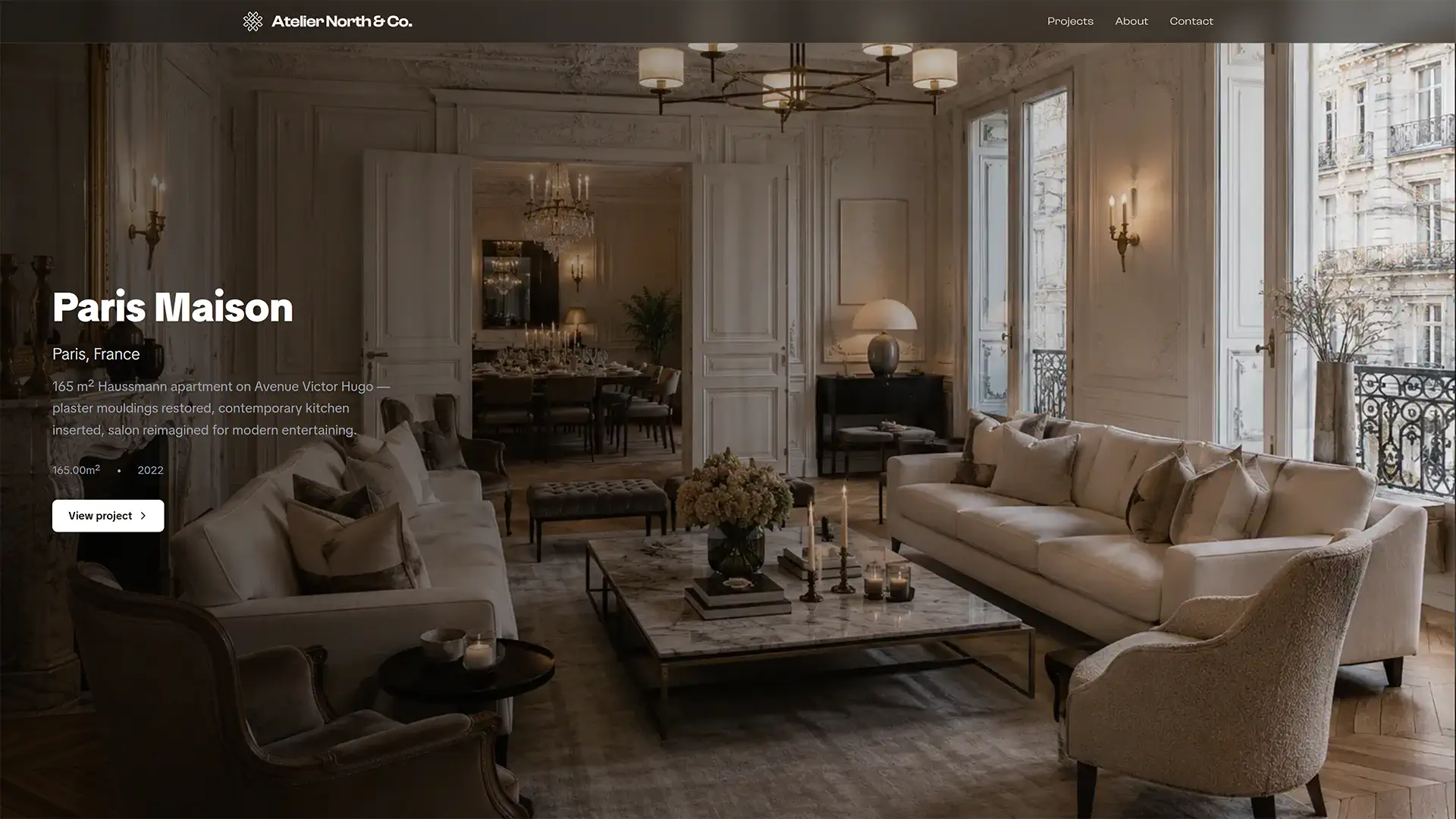
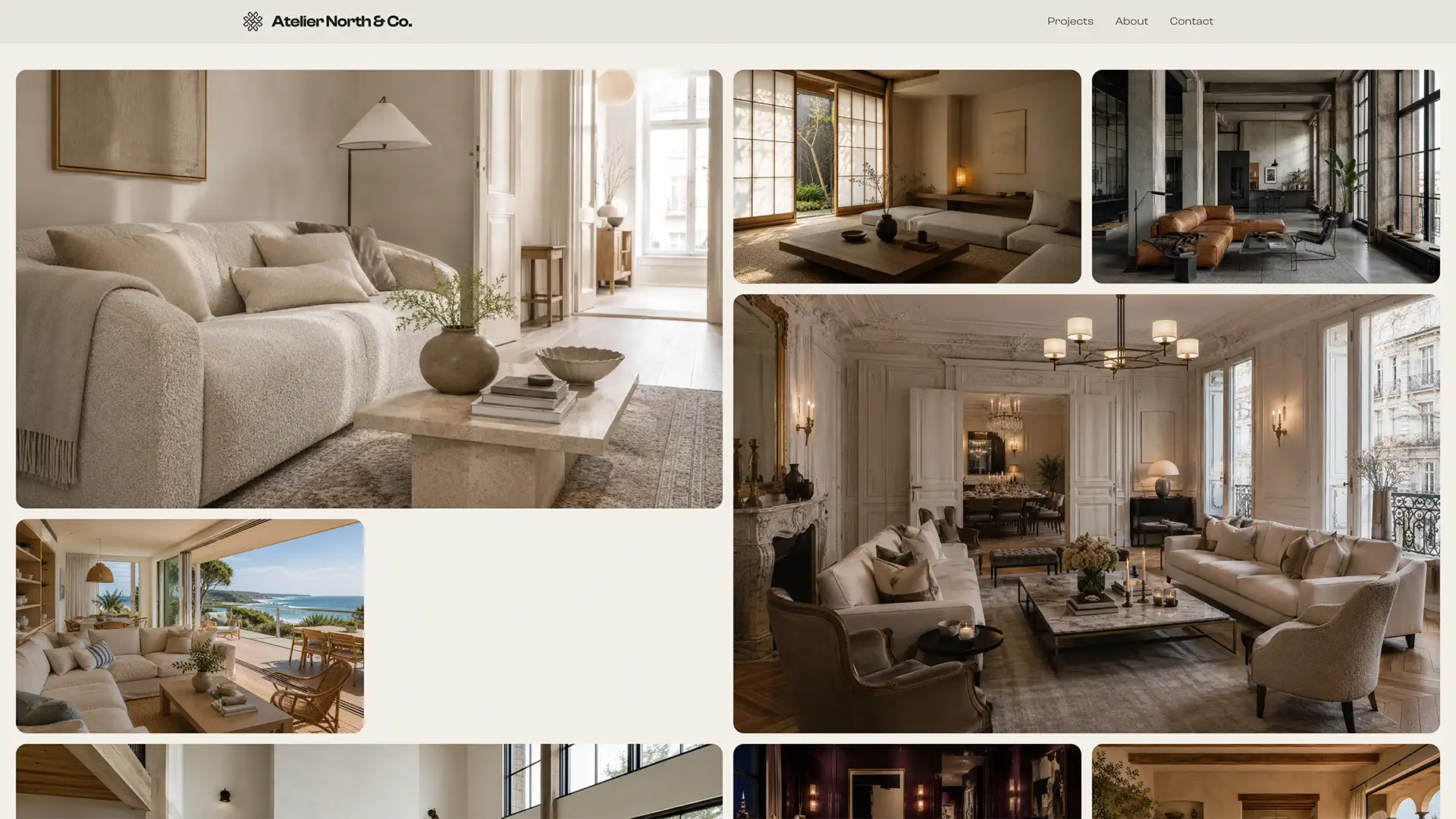
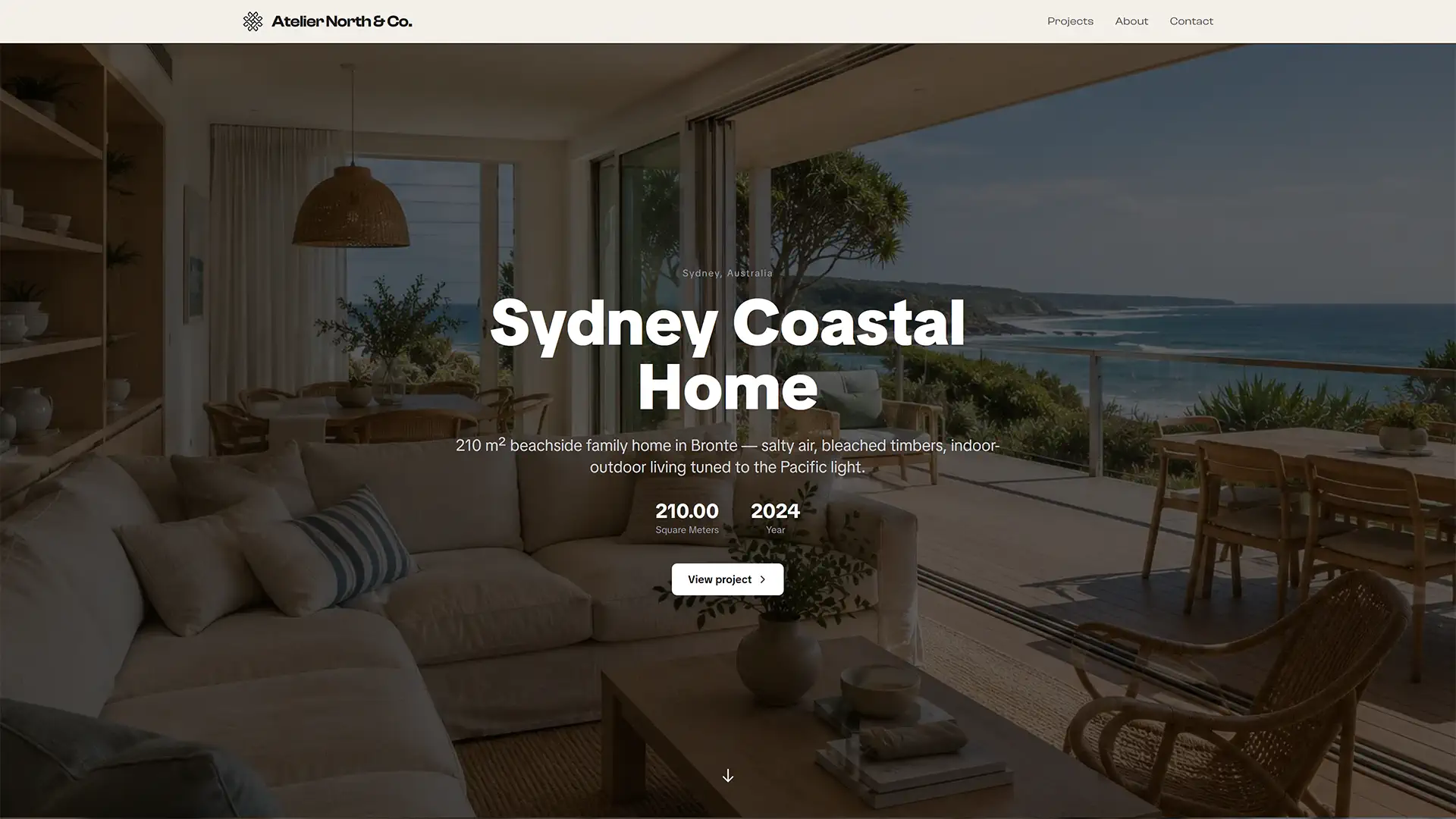
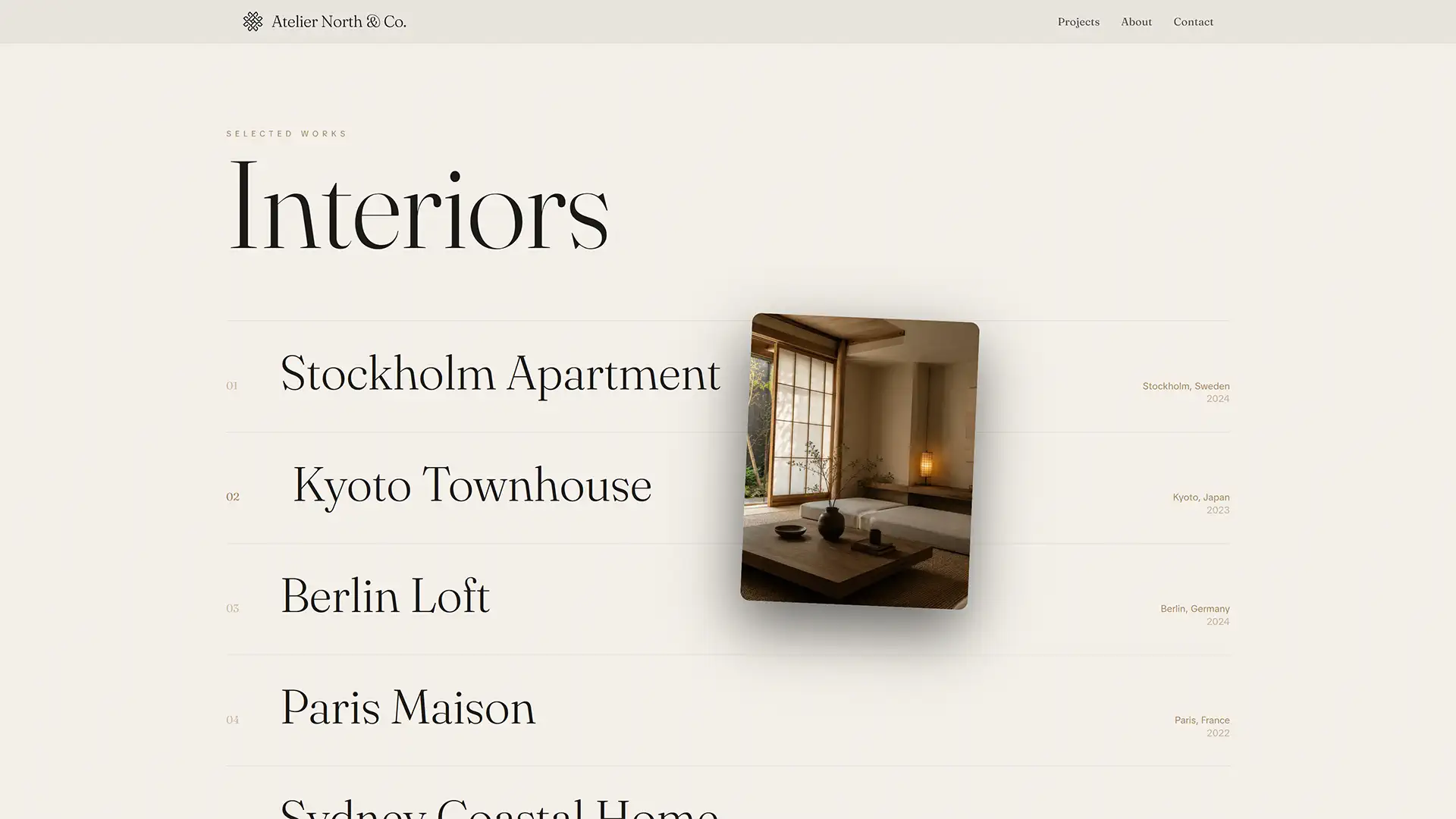
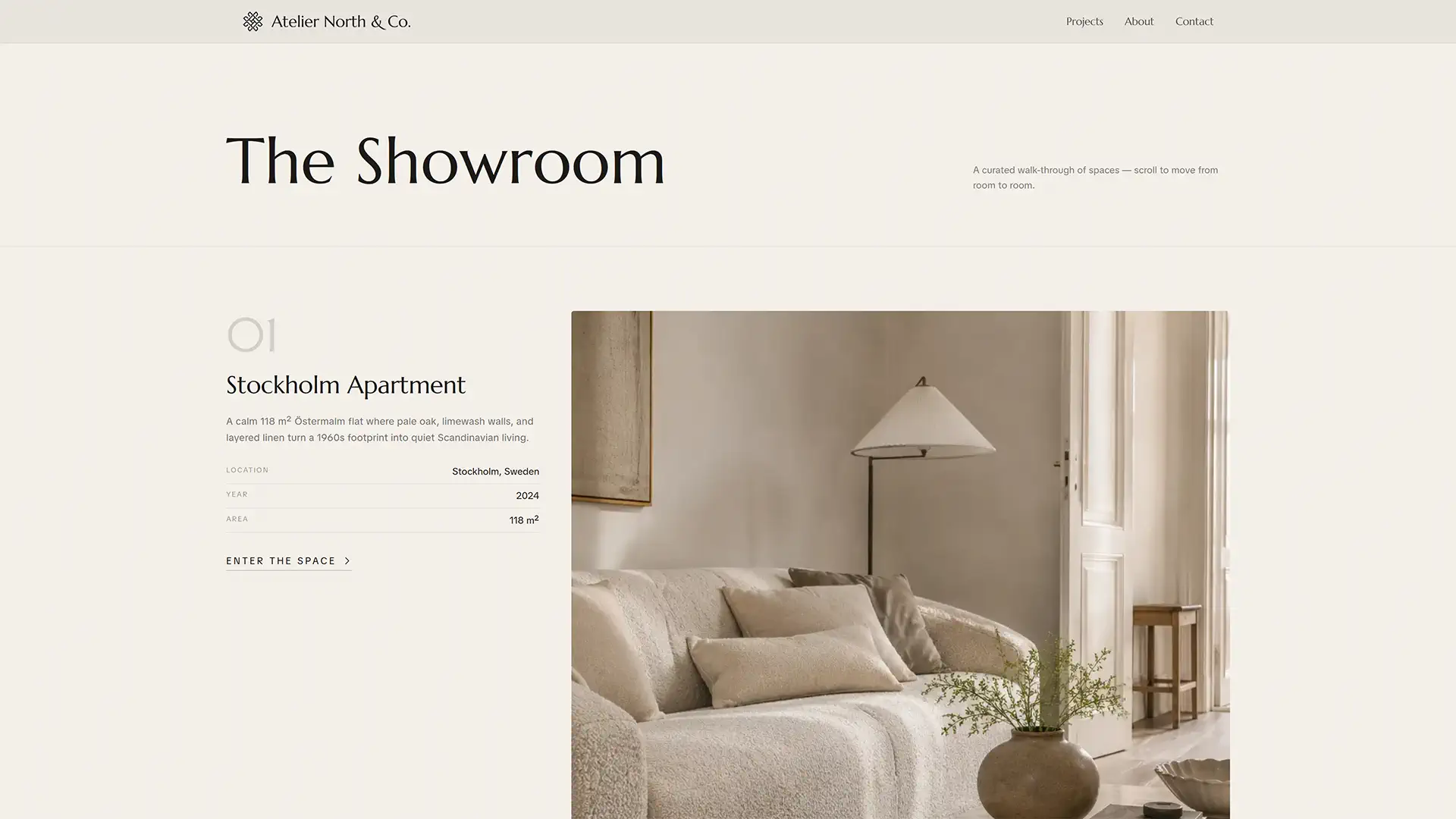
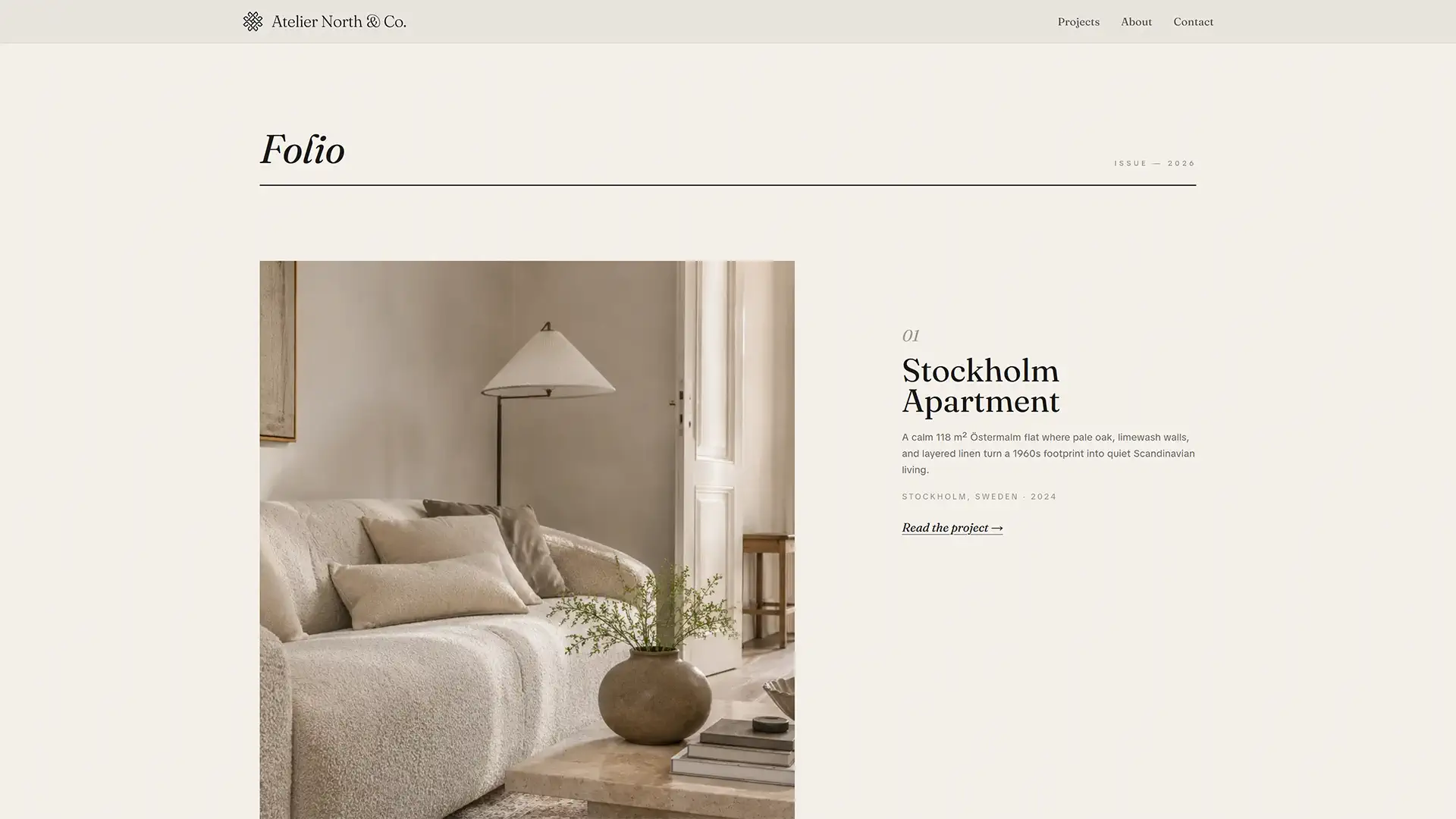
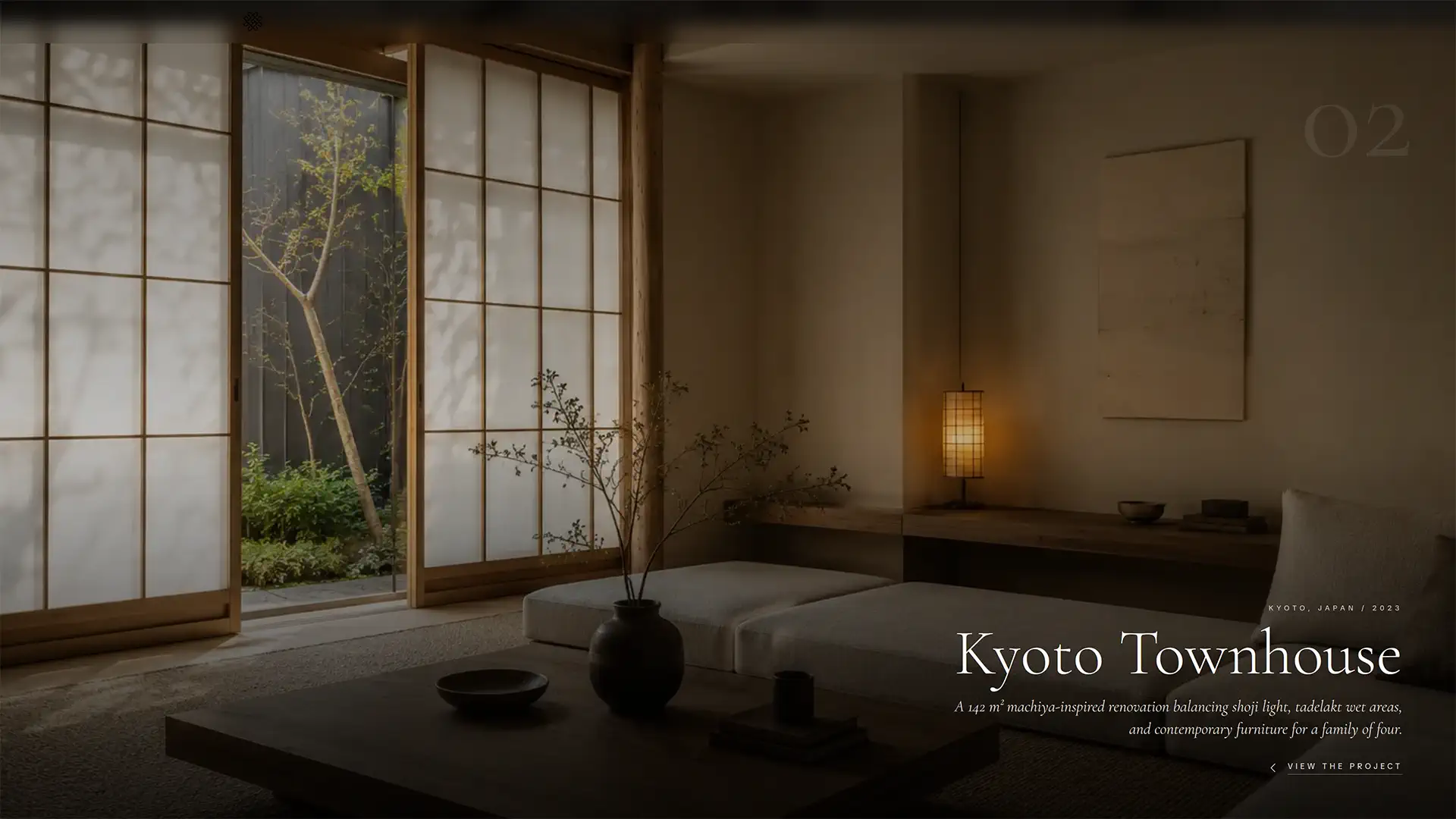
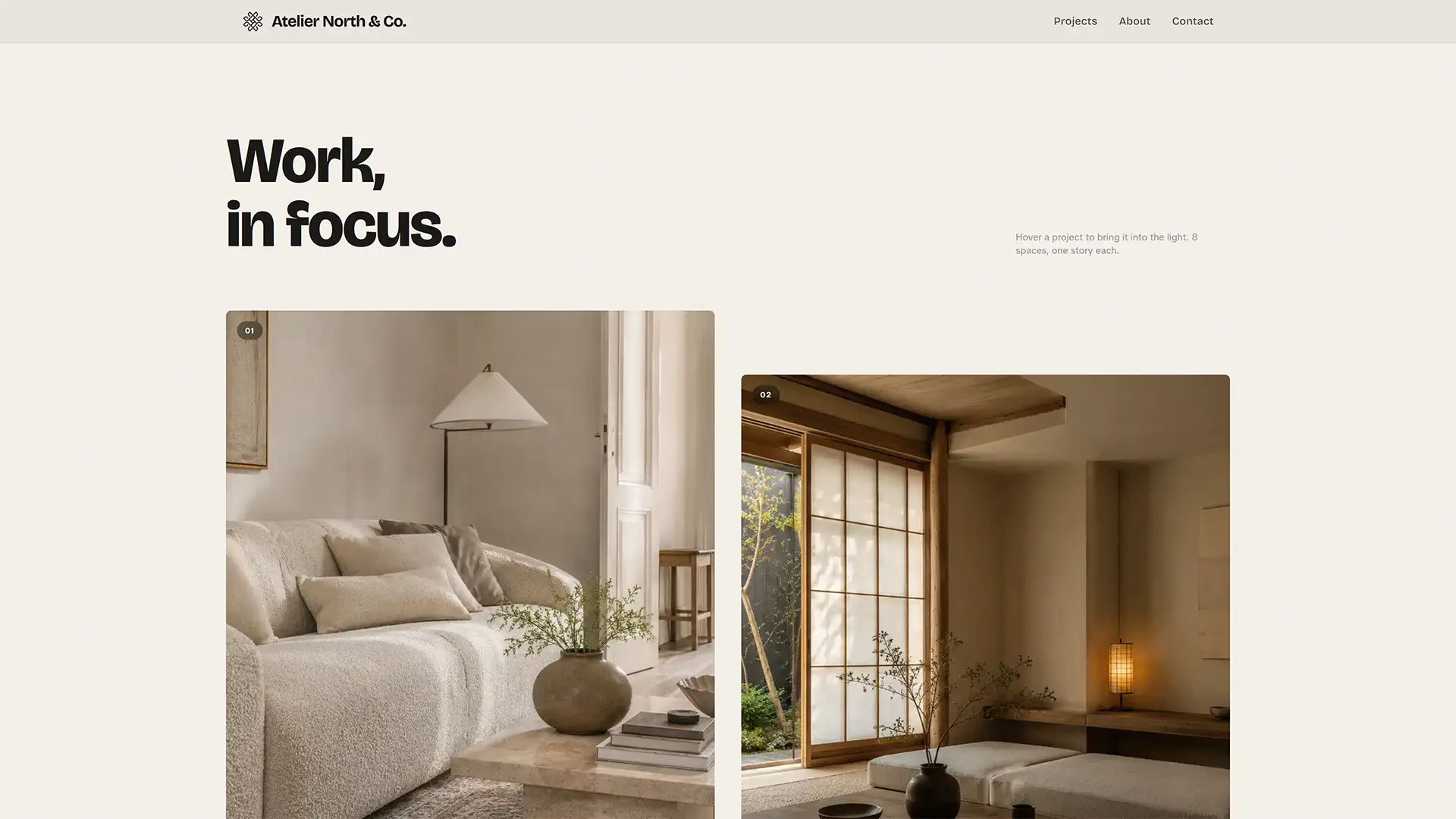
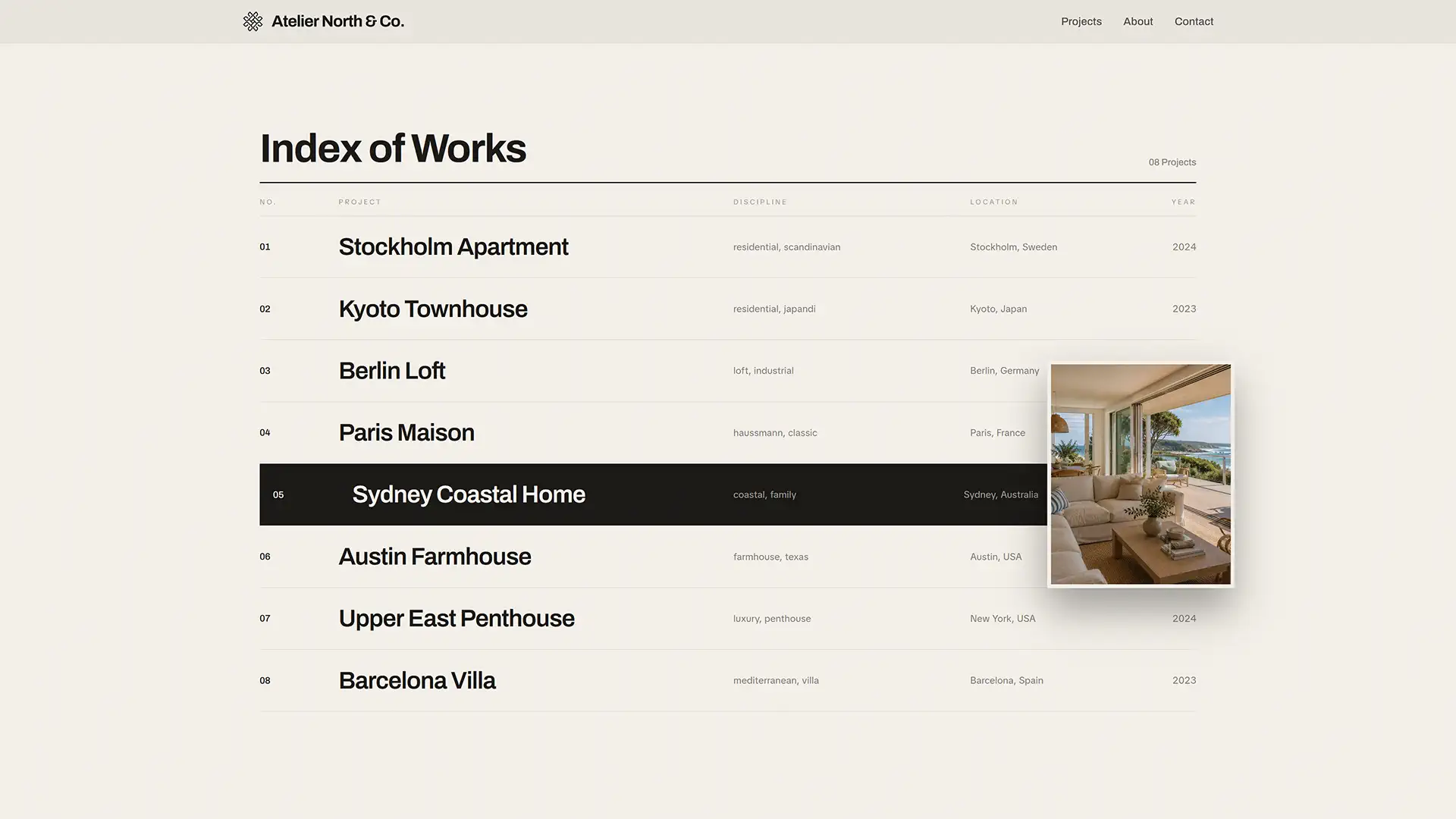
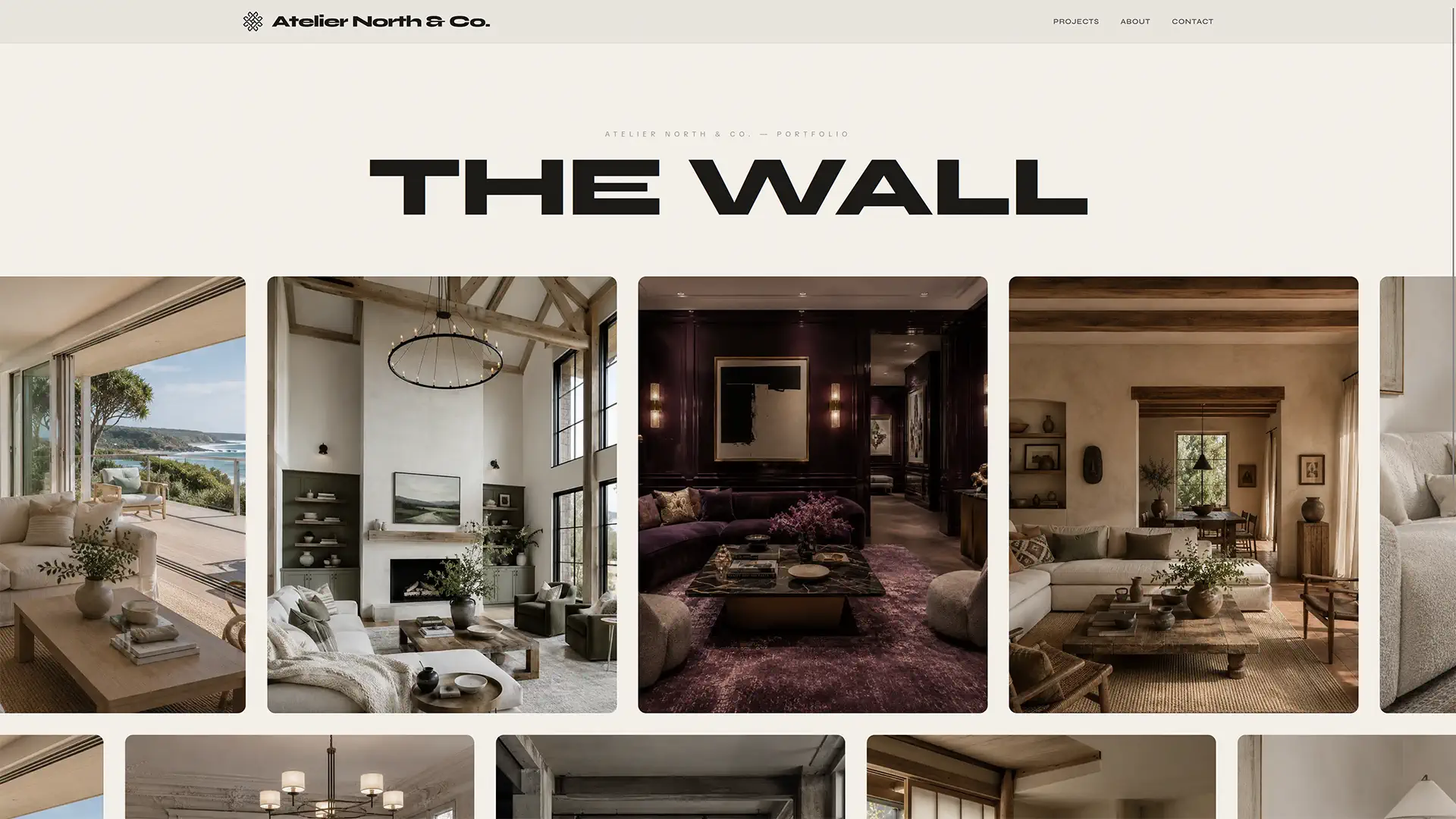
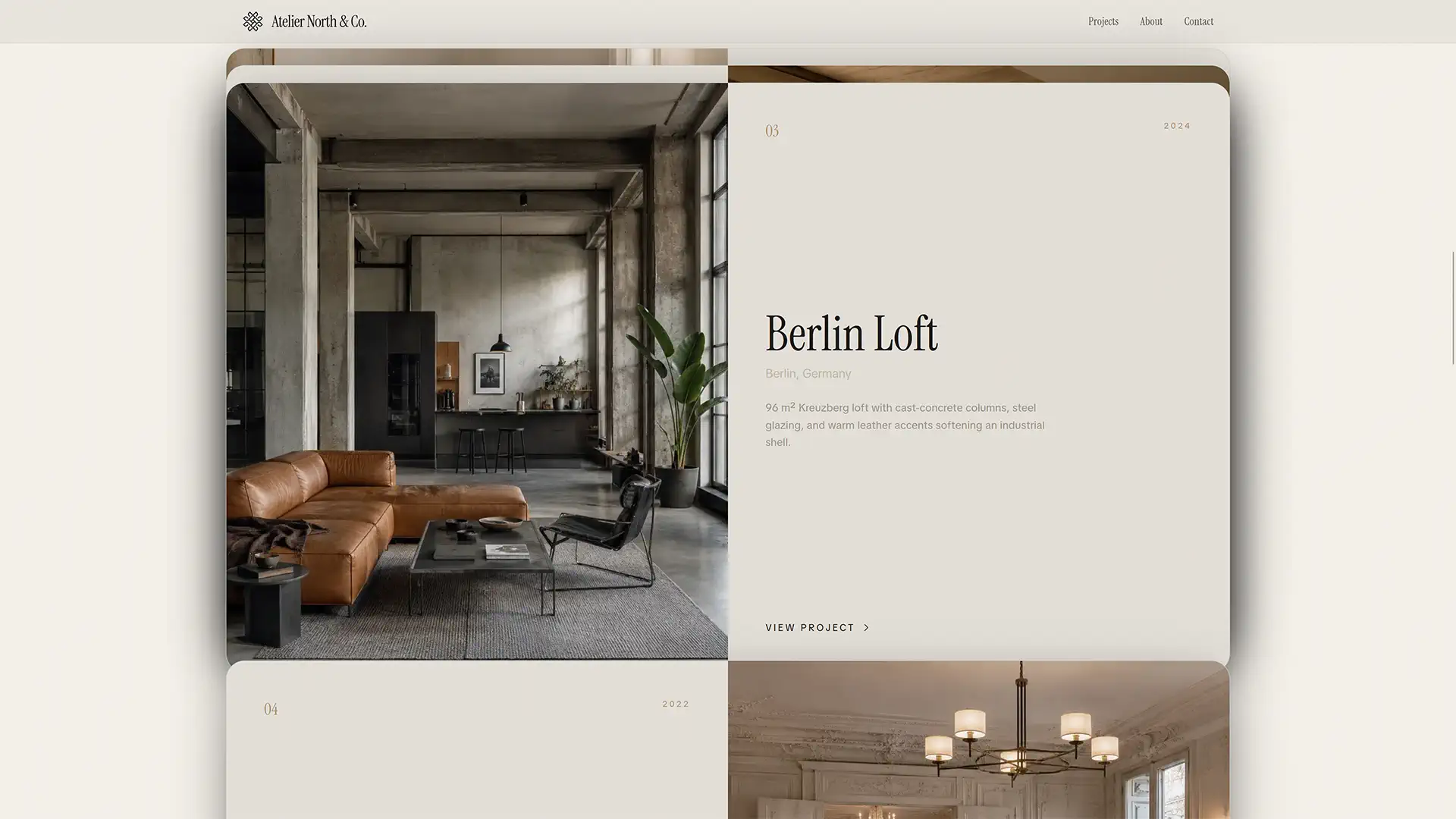
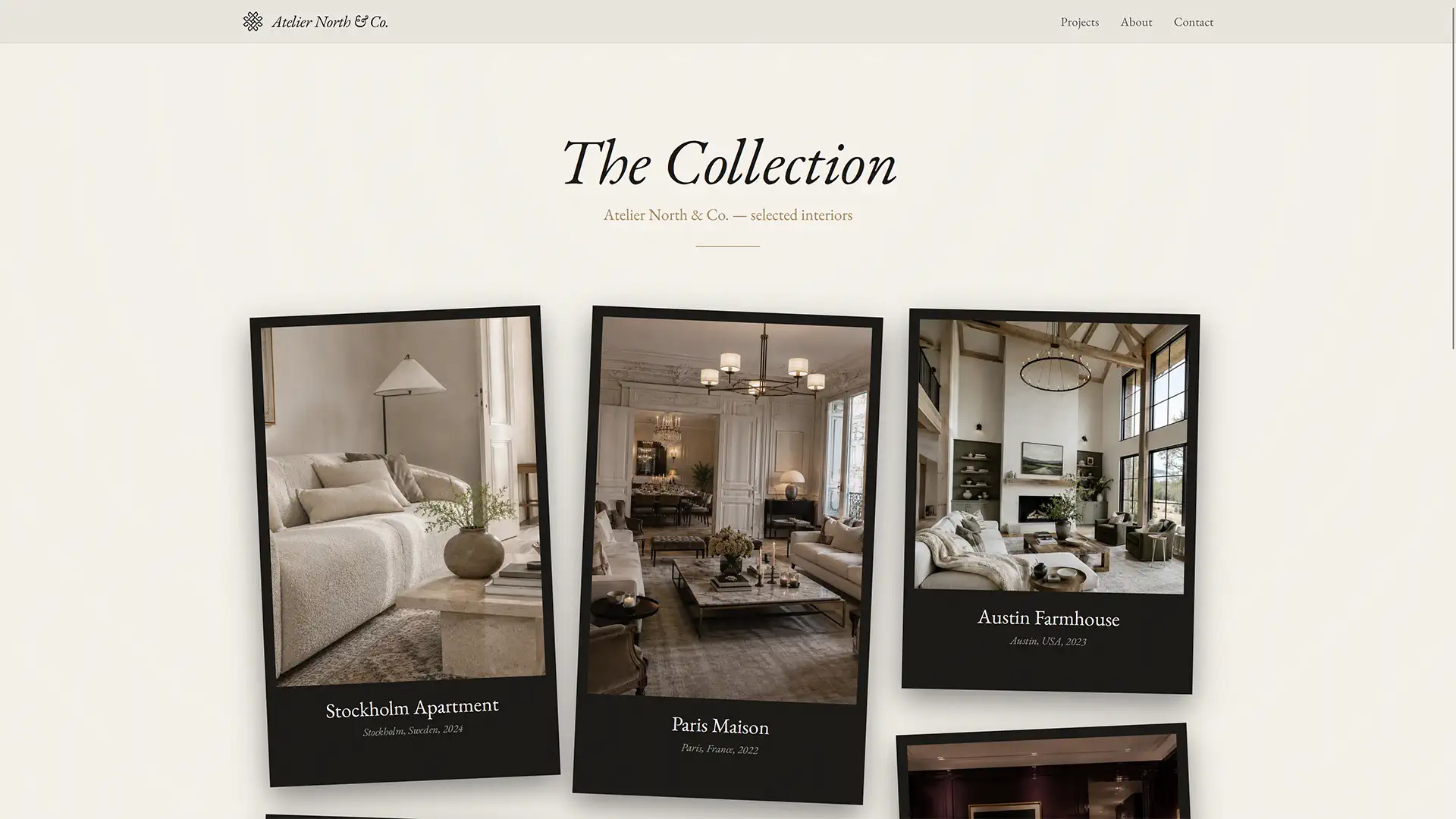
The fastest way to understand what works is to study real, published portfolios. Browse our gallery
of interior design portfolio examples — every layout there is
a live, publishable template, not a static mock-up. Notice how the strongest examples share the same
fundamentals: a confident opening image, generous whitespace that lets the photography breathe,
clear project grouping, and an unmissable contact path. You will also see different layout
personalities — minimal grids for light, airy work; cinematic full-bleed galleries for dramatic
spaces — so you can identify which structure flatters your photography.
How to build an interior design portfolio for free
You do not need to hire a web designer or learn to code. The
interior design website builder was made specifically for
interior designers: you start from real gallery templates you preview up front, add your projects,
and publish on a clean URL — most designers go live in under an hour. PDF export, a built-in contact
form and SEO-ready pages come included, so your portfolio reaches clients and converts them.
If you want the build process broken into clear stages, follow our
step-by-step guide to making an interior design portfolio.
And before you publish, run through the free
interior design portfolio checklist so nothing is
missing.
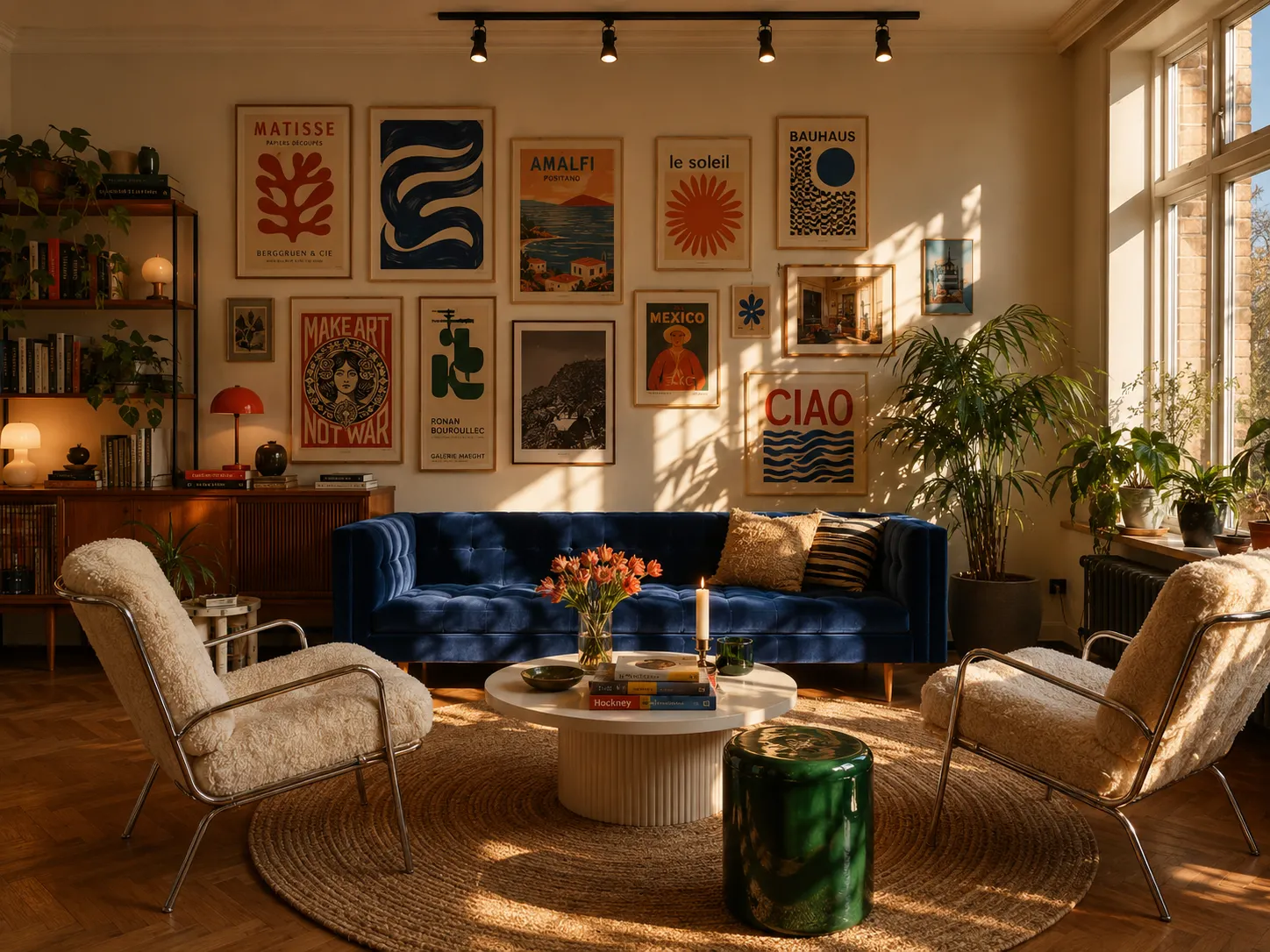
Photography: the factor that makes or breaks a portfolio
If you only improve one thing, improve your photography. Interior design is a visual discipline, and
clients cannot separate the quality of the space from the quality of the image showing it. Blurry,
badly lit or inconsistent photos make even excellent design look amateur, while consistent,
well-composed images make modest projects look polished.
A few principles carry most of the weight:
- Shoot in consistent light. Natural daylight is usually the most flattering for interiors. Aim
for a consistent feel across your whole gallery so the portfolio reads as one coherent body of work
rather than a scrapbook.
- Mix wide and detail shots. Lead each project with a wide establishing shot that explains the
space, then support it with detail shots of materials, joinery, textures and styling. The details
are what prove craft.
- Straighten your verticals. Wonky walls and converging lines are the fastest tell of an amateur
photo. A tripod and a little care fix most of it.
- Style before you shoot. Clear clutter, add a few considered props, and treat the shoot as part
of the design work — because in your portfolio, it is.
If hiring a professional photographer for every project is not realistic yet, learn the fundamentals
and shoot in good daylight. Consistency across your gallery matters more than any single hero image.
A portfolio for every career stage
The fundamentals are the same at every stage, but the emphasis shifts:
- Students and graduates. You will lean on studio projects, concept work and personal spaces.
Present them as real case studies, foreground your process, and publish online so recruiters can
find you after a career fair. Quality of presentation closes most of the gap with experience.
- Career changers. Bring transferable skills forward — project management, client relationships,
a related creative background — and build two or three speculative or personal projects to
demonstrate applied skill. A clear About page that frames your pivot as a strength does a lot of
work here.
- Established designers. Your challenge is curation and currency, not volume. Prune older or
off-brand work, keep only what reflects where you are heading, and refresh as new projects
complete. An established designer's portfolio should feel edited, not exhaustive.
Getting your portfolio found
A portfolio nobody sees cannot win work, so discoverability matters. You do not need to be an SEO
expert, but a few basics compound over time:
- Publish on your own URL so search engines can index your work under your name and niche.
- Write descriptive page titles and image alt text — design portfolios are image-heavy, and alt
text is how search engines understand your visuals.
- Add a short, keyword-aware narrative to each project so there is real text to rank, not just
images.
- Share the link everywhere — Instagram bio, Pinterest, LinkedIn, email signature and proposals
— to build the kind of signals that help a site get found.
A purpose-built platform handles the technical side (clean markup, structured data, automatic
sitemaps) so you can focus on publishing strong, well-described work. Over months, this is what turns
a portfolio from a link you send into a channel that brings enquiries to you.
Common mistakes to avoid
A few recurring mistakes quietly cost designers enquiries:
- Too many projects, weakly curated. Twenty average projects are worse than eight outstanding
ones.
- Low-quality or inconsistent photography. Inconsistent lighting and resolution undermine even
great design. Invest in (or learn) good photography.
- No story. A grid of pretty images with no context leaves clients guessing what you actually did.
- Hidden contact details. If enquiring is not obvious within a few seconds, visitors leave.
- Never updating it. A portfolio that ends three years ago signals a stalled practice. Refresh it
as projects complete.
Avoid these and you are already ahead of most of your competition.
Treat your portfolio as a living asset
The best portfolios are never "finished". They are reviewed and refined as your practice grows. A
simple rhythm keeps yours sharp:
- Every new project: decide whether it is stronger than your current weakest project. If it is,
add it and remove the weakest. If it is not, leave it out.
- Every quarter: reread your narratives and About page. Does the positioning still match the
clients you want? Tighten anything that has drifted.
- Every year: review the portfolio as a whole. Has your style matured? Are you still leading with
your strongest work? Does anything feel dated?
It is also worth paying light attention to results. If you have analytics, notice which projects
people spend time on and which pages lead to enquiries, and weight your portfolio toward what
clearly resonates. A portfolio that evolves with your work is itself a signal of a thriving,
forward-moving practice — exactly the impression you want a prospective client to leave with.
When you are ready, pick a layout, add your strongest projects, and publish a portfolio that does its
job — turning visitors into clients.