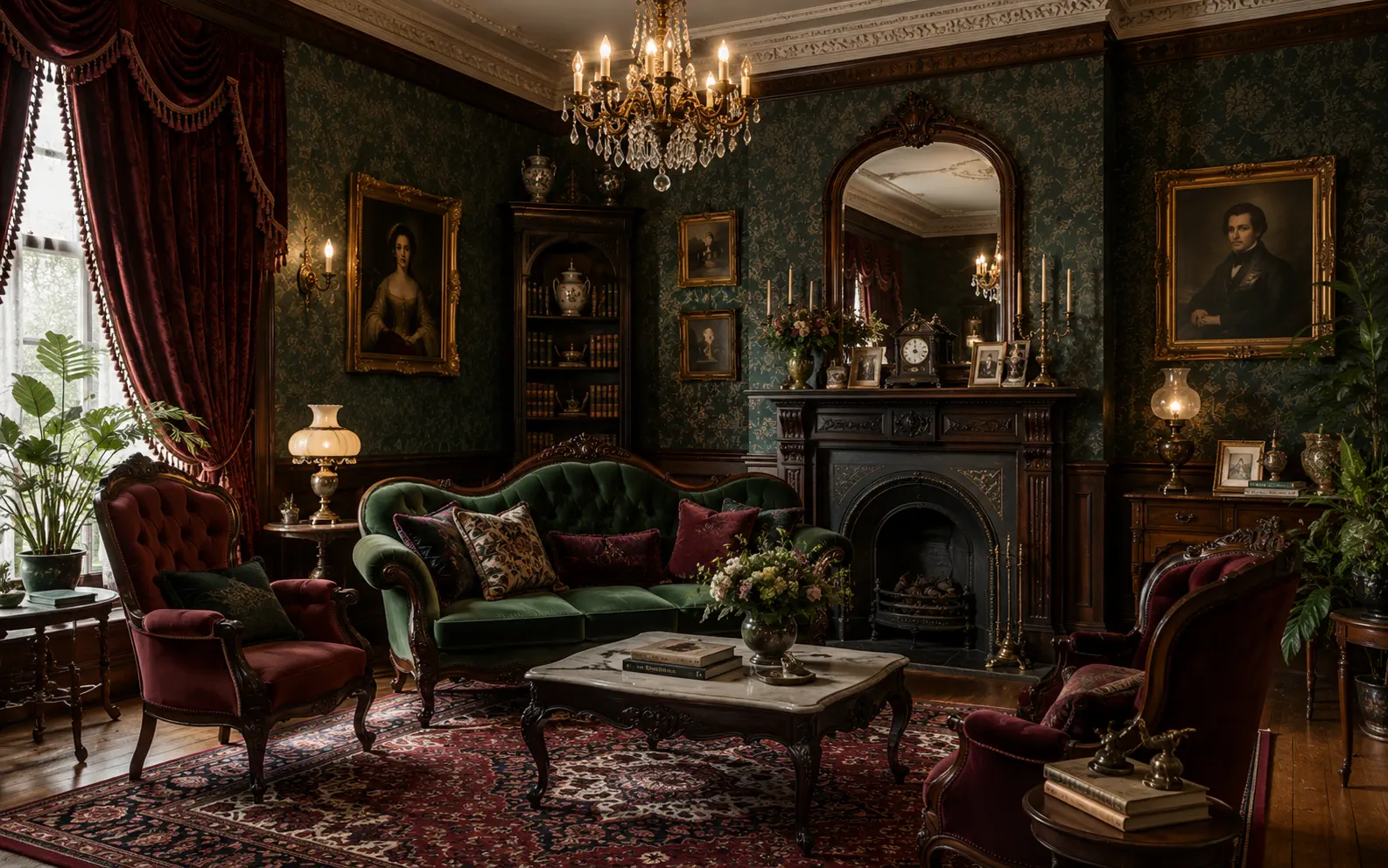
Victorian style interior design is the most unapologetically decorative look in the interiors vocabulary. Named for the long reign of Queen Victoria (1837–1901), it emerged in an era of industrial abundance, global trade and rising middle-class confidence — and it shows. Where minimalism removes, Victorian design adds: deep saturated colour, patterned wallpaper, carved dark wood, layered textiles and surfaces crowded with treasured objects. This guide covers what defines Victorian interiors, the palette and materials behind them, and how to capture the drama in a modern home without it feeling like a museum.
Victorian sits at the ornate end of the traditional family. To see how it compares with the calmer classic looks, browse the guide to interior design styles or download the printable interior design styles guide.
What is Victorian style interior design?
Victorian interiors were a display of comfort and status. For the first time, mass production made patterned wallpaper, textiles, furniture and decorative objects widely affordable, while trade and empire brought exotic materials and motifs within reach. The result was a maximalist aesthetic in which abundance itself was the point: a well-appointed room was a full room.
Architecturally, the style is supported by generous period features — high ceilings, deep skirting boards, ornate cornicing and ceiling roses, panelled doors, sash windows, and above all a fireplace as the undisputed focal point of every principal room. Layered on top came heavy curtains, richly patterned papers, dark polished woodwork and an abundance of framed pictures, mirrors, china and curiosities.
The mood is enveloping and theatrical rather than airy. Victorian rooms are designed to feel warm, enclosed and richly furnished — the opposite instinct to almost every twentieth-century style that followed.
The defining features of Victorian design
The style is easy to identify once you know its signatures:
- Deep, saturated colour — burgundy, forest green, navy, plum, mustard and rich browns.
- Patterned wallpaper — florals, damask, botanical and William Morris–style repeats, often with a dado rail dividing the wall.
- Dark, carved wood — mahogany, walnut and oak in heavily worked furniture and joinery.
- Ornate architectural detail — cornicing, ceiling roses, deep skirtings, panelled doors.
- A fireplace as focal point — cast iron or marble, with decorative tiles and a mantel display.
- Layered, heavy textiles — velvet, brocade, damask, lace, fringing and tassels.
- Abundant decoration — gilt mirrors, framed pictures hung densely, china, glass domes, plants.
- Patterned floors — encaustic tile in halls, timber boards with richly patterned rugs elsewhere.
Nothing is spare, and that is deliberate: the richness is the style.
Palette, materials and pattern
The Victorian palette is deep and warm. Principal rooms took strong colours — burgundy and oxblood, bottle and forest green, navy and midnight blue, plum, ochre and mustard — often paired with dark woodwork and warm metallics. Lighter tones appeared in bedrooms and morning rooms, but even those tended towards rich creams and dusty pinks rather than crisp white.
Materials are heavy and tactile: polished dark hardwood, cast iron, marble, brass, coloured and etched glass, and glazed decorative tile around fireplaces and in entrance halls. Textiles carry enormous weight — velvet and brocade upholstery, damask and lace at the windows, deep-pile patterned rugs, and trimmings like fringe and tassels used freely.
Pattern is used more confidently here than in any other historic style. Wallpaper is the classic vehicle, frequently with a different treatment above and below a dado rail, and florals or damask may appear alongside a patterned rug and patterned upholstery in the same room. The trick that keeps it coherent is a shared palette: several patterns can coexist happily when they draw on the same handful of colours.
Furniture and decorative objects
Victorian furniture is substantial, curvaceous and heavily worked. Look for button-backed and deep-buttoned upholstery, chesterfield sofas, balloon-back and carved dining chairs, roll-top desks, glass-fronted display cabinets, chaise longues, marble-topped washstands and occasional tables in profusion. Legs are turned or cabriole; edges are carved; upholstery is generous.
Display is central to the style. Mantels and cabinets carry clocks, candlesticks, china, glass domes and family photographs; walls hold densely arranged pictures in gilt frames and large mirrors; corners hold palms and ferns in decorative pots. The Victorians also loved the natural-history cabinet: pressed botanicals, shells and curiosities under glass. The effect should read as a lifetime of collecting, not a single shopping trip.
Victorian style in a modern home
Full-blooded Victorian decoration is a lot for contemporary life, so most people adopt a modernised version — and it works beautifully. The reliable approach is to keep the drama and lose the density: choose one or two deep, saturated colours; use patterned wallpaper on a single feature wall or in a hall, cloakroom or dining room rather than everywhere; restore and celebrate original features like the fireplace and cornicing; and select a handful of genuinely good Victorian pieces instead of filling every corner.
Modern comfort and lighting solve the style's historic weaknesses. Victorian rooms were dim by necessity; today, layered lighting — a statement pendant, wall lights, table lamps — delivers the enveloping mood without the gloom. Balancing rich ornament against some clear space and plainer modern upholstery keeps a Victorian scheme feeling intentional rather than oppressive. The underlying principles of balance, scale and contrast that make this work are covered in the guide to the elements of interior design.
Common Victorian mistakes
The first mistake is density without editing — every wall papered, every surface loaded, every window swagged. Authenticity is not the goal; livability is. Give the eye somewhere to rest.
The second is losing the light. Dark colours and heavy curtains in a small, north-facing room can turn cosy into cave-like. Reserve the deepest tones for rooms that can carry them, or rooms you mainly use in the evening, and invest in generous layered lighting.
The third is fake period detail: thin, poorly proportioned reproduction cornicing or a token mock fireplace undermines the whole scheme. Restore what is genuinely there, choose a few authentic pieces, and let quality rather than quantity carry the style. Designers working on period properties will find that this kind of restoration photographs superbly for a portfolio — you can build a designer website and get started free to show it.
Frequently asked questions
What is Victorian style interior design?
Victorian style interior design comes from the era of Queen Victoria (1837–1901) and is defined by rich decoration: deep saturated colours, patterned wallpaper, dark carved wood, ornate cornicing and ceiling roses, a fireplace as the focal point, heavy layered textiles like velvet and damask, and surfaces filled with pictures, mirrors, china and curiosities. It is warm, enveloping and deliberately abundant.
What colours are used in Victorian interiors?
Principal rooms used deep, warm, saturated colours — burgundy and oxblood, forest and bottle green, navy, plum, ochre and mustard — usually paired with dark polished woodwork and warm metallics such as brass. Bedrooms and morning rooms were lighter, but tended towards rich creams and dusty pinks rather than crisp modern white.
How do I get a Victorian look in a modern home?
Keep the drama but reduce the density: pick one or two deep colours, use patterned wallpaper in a single room or on a feature wall, restore and celebrate original features like the fireplace and cornicing, and choose a few genuinely good Victorian pieces rather than filling every surface. Layered modern lighting gives you the enveloping mood without the historic gloom.
What is the difference between Victorian and traditional interior design?
Victorian is the most ornate branch of the traditional family. Traditional design is classic, symmetrical and comfortable but relatively restrained, whereas Victorian pushes much further into deep saturated colour, dense pattern, heavily carved dark wood, layered trimmed textiles and crowded decorative display. Victorian is traditional design turned up to maximalism.